
Tag: Market Analysis

  • Polymarket Embraces Multi-Chain Future with Binance Coin (BNB) Integration, Expanding Prediction Market Accessibility

    Polymarket Embraces Multi-Chain Future with Binance Coin (BNB) Integration, Expanding Prediction Market Accessibility

    In a significant move poised to reshape the landscape of decentralized prediction markets, Polymarket has officially integrated Binance Coin (BNB) deposits and withdrawals. Reports from October 2025 confirm the recent rollout of this crucial functionality, marking a pivotal moment for both the platform and the broader Web3 ecosystem. This integration is not merely an addition of another cryptocurrency; it represents a strategic leap towards a more accessible, scalable, and interconnected future for prediction markets, leveraging the robust infrastructure of the BNB Chain.

    The immediate implications of this development are overwhelmingly positive, ushering in an era of enhanced multi-chain access for users worldwide. By welcoming BNB, Polymarket (POLY) is broadening its appeal to the vast user base within the BNB Chain ecosystem, allowing more participants to engage with their preferred digital asset. This strategic expansion positions Polymarket as a versatile and user-friendly hub, significantly reducing friction for both retail and institutional users eager to participate in the burgeoning world of decentralized forecasting.

    Market Impact and Price Action

    The integration of Binance Coin (BNB) into Polymarket’s (POLY) ecosystem unfolds against a backdrop of significant strategic expansion for the prediction market giant. In October 2025, Polymarket secured a staggering $2 billion investment from Intercontinental Exchange (NYSE: ICE), the parent company of the New York Stock Exchange, catapulting its valuation to an estimated $8-9 billion. Further solidifying its regulatory standing, Polymarket also acquired QCEX, a CFTC-licensed derivatives exchange, enabling legal operations within the United States. This aggressive growth strategy has fueled an impressive surge in activity, with weekly trading volumes on Polymarket surpassing $2 billion in mid-October 2025, capturing over half of the total prediction market volume.

    Despite Polymarket's robust expansion and the inherent positive implications of the BNB integration, Binance Coin (BNB) has experienced some downward pressure in the immediate aftermath. As of October 22, 2025, BNB was trading around $1,072, reflecting a 10% decrease over the preceding seven days. The token recently achieved an all-time high of $1,375 but has since encountered sell-side pressure. Market analysts are closely watching the critical support level of $1,000, as a failure to maintain this could lead to a more significant correction towards $845. While some forecasts for October 2025 anticipated a moderate upward trajectory for BNB under favorable market conditions, the current sentiment leans towards caution, highlighting that even positive platform news can be overshadowed by broader market forces.

    The integration is expected to yield several long-term positive impacts on BNB’s market dynamics, primarily by increasing its utility and demand. Users participating in Polymarket’s prediction markets via the BNB Chain will require BNB to cover transaction fees, directly boosting the token's inherent value proposition. This enhanced utility is anticipated to drive up trading volumes for BNB as more users acquire and transfer the cryptocurrency to engage with Polymarket. Furthermore, the ability to seamlessly move BNB to and from Polymarket's platform could influence liquidity, potentially increasing BNB's presence within the decentralized application's ecosystem.

    Historically, the growth of decentralized applications on major blockchains like Ethereum (ETH) has consistently driven up the price of their native tokens due to increased demand for gas fees and ecosystem participation. Similarly, successful multi-chain integrations and cross-chain functionality are crucial for expanding a dApp's reach and fostering a more interconnected Web3 environment. While initial integration announcements might generate a burst of positive sentiment, the sustained market impact on BNB will ultimately hinge on the actual user adoption and the consistent utility derived from Polymarket's presence on the BNB Chain, reinforcing the long-term network effect.

    Community and Ecosystem Response

    Polymarket's integration of Binance Coin (BNB) has been met with a largely enthusiastic and strategic reception across the crypto community and ecosystem, particularly in the current climate of October 2025. This move is widely perceived as a crucial step in Polymarket’s aggressive multi-chain expansion and a significant validation of BNB Chain’s strategic pivot into the burgeoning prediction market sector. The timing aligns perfectly with Polymarket's recent institutional backing, including a substantial $2 billion investment from Intercontinental Exchange (NYSE: ICE), which has injected unprecedented credibility and bridged traditional finance with decentralized finance. The BNB Chain's reputation for speed, low transaction costs, and robust oracle integrations makes it an inherently attractive platform for high-throughput applications like prediction markets, further bolstered by Binance's (BNB) proactive efforts to position its chain as a foundational layer for such innovative startups.

    While specific, granular social media posts directly addressing the BNB integration are still emerging, the overarching sentiment surrounding both Polymarket and BNB in October 2025 is overwhelmingly positive and bullish. BNB has recently demonstrated significant market strength, notably surpassing XRP in market capitalization, with analysts forecasting further upward movement. This bullish outlook for BNB is underpinned by strong fundamentals and increasing DeFi activity on the BNB Chain. Concurrently, Polymarket continues to dominate discussions within the prediction market sphere, frequently cited for its groundbreaking institutional investments, regulatory clarity in the U.S., and innovative partnerships, such as with the NHL. Terms like "bullish sentiment," "optimism," and "growing social proof" are frequently used across crypto Twitter and Reddit, indicating a widespread favorable community response to the platform's strategic moves.

    The integration is not only enhancing Polymarket's capabilities but is also catalyzing significant innovation and expansion within the broader DeFi and Web3 ecosystems. The BNB Chain has issued an "open invitation" to developers to build prediction markets on its platform, signaling a strategic push to diversify beyond its traditional strengths in DeFi and gaming. Initiatives like the Seedify Prediction Markets Hackathon, powered by BNB, offer substantial rewards and mentorship, specifically encouraging the development of new tools, analytics, and even AI-powered decision-making applications that can leverage Polymarket's API or create new DeFi primitives on the BNB Chain. Furthermore, Polymarket's expansion as a Mini App within Sam Altman’s World App, facilitating WLD and USDC-based prediction bets, exemplifies a broader trend towards enhanced accessibility and simplified user experiences within Web3. This strategic collaboration is expected to drive increased on-chain activity, boost liquidity demand for BNB, and potentially amplify its deflationary tokenomics, contributing to the "prediction market gold rush" that is now fostering new infrastructure, tools, and aggregation platforms across the ecosystem.

    What's Next for Crypto

    Polymarket's strategic integration of Binance Coin (BNB) deposits and withdrawals, effective as of October 2025, represents a pivotal moment with far-reaching implications for the crypto market, prediction markets, and the BNB Chain ecosystem. This development, coupled with Polymarket’s recent $2 billion investment from Intercontinental Exchange (NYSE: ICE) and key partnerships with platforms like World App and MetaMask, positions the platform for accelerated growth and highlights the increasing maturity of prediction markets as a financial instrument.

    In the short term, from late 2025 onwards, we anticipate an immediate expansion of Polymarket's user base and liquidity. By directly tapping into BNB Chain's vast and active network, which boasts over 2.2 million daily active users on Binance Smart Chain (BSC) and nearly 2 million on opBNB, Polymarket stands to gain a rapid influx of new participants and capital—a critical factor for the efficiency and accuracy of prediction markets. BNB Chain's renowned low transaction fees and fast processing times will offer a more cost-effective and efficient user experience, appealing to those previously deterred by higher gas fees or slower transactions on other networks. This move will also significantly boost BNB Chain's decentralized finance (DeFi) ecosystem, drawing in more diverse dApps and strengthening BNB Chain's position as a hub for on-chain trading and scalability. Furthermore, Polymarket's enhanced multi-chain capabilities will strengthen its competitive edge, while ongoing speculation around a potential Polymarket native token and airdrop, possibly leveraging this BNB integration, could generate immediate interest and activity.

    Looking ahead, the long-term implications are even more profound. This integration, alongside Polymarket’s institutional backing, pushes prediction markets further into the mainstream, potentially shedding their "gambling" stigma and gaining recognition as legitimate tools for information aggregation and risk management. Prediction markets are evolving beyond mere speculation to become valuable instruments for real-time intelligence gathering, assisting even crypto SMEs with anticipating policy shifts. This move also strengthens BNB Chain's strategic role as a foundational layer for DeFi, attracting a more diverse array of decentralized applications and solidifying its infrastructure-backed growth through continuous technological upgrades like the Lorenz/Maxwell hardforks and gasless transactions. However, increased visibility on a major chain like BNB could also attract renewed regulatory scrutiny globally, necessitating careful compliance strategies. Crucially, Polymarket's recent partnership with Chainlink (LINK), enabling 15-minute crypto markets and automated, oracle-powered resolution, is a critical long-term development that enhances accuracy, speeds up settlement, and builds trust within the ecosystem.

    Several catalysts could significantly accelerate the impact of Polymarket's BNB integration. An eagerly anticipated official Polymarket token launch and airdrop, especially if targeted at active users on integrated chains like BNB, could provide an immense boost. Further regulatory clarity and approvals, particularly for Polymarket's re-entry into the U.S. market, would unlock massive growth potential. Expanding market offerings, particularly those leveraging Chainlink's enhanced oracle capabilities for more complex questions, and major global events (such as upcoming elections) that historically drive volume, will also fuel interest. Finally, continued strategic integrations with major crypto wallets, DeFi platforms, and even Web2 applications will be key to onboarding millions of new users by simplifying access.

    For projects, embracing interoperability, leveraging reliable oracle solutions, focusing on user experience, proactive regulatory engagement, and deep ecosystem integration are paramount. Investors, meanwhile, should conduct thorough due diligence, assess the potential impact on BNB and related ecosystem tokens, evaluate Polymarket's growth trajectory and potential token launch, and consider using prediction markets as a valuable sentiment gauge. While an optimistic scenario foresees exponential growth and mainstream adoption, a moderate scenario suggests steady growth and niche expansion. A pessimistic outlook, however, warns of potential regulatory headwinds and stifled innovation, underscoring the dynamic and often unpredictable nature of the crypto landscape.

    Bottom Line

    Polymarket's integration of Binance Coin (BNB) deposits and withdrawals, unfolding in October 2025, is a seminal event that underscores a profound maturation in the crypto ecosystem. For investors and enthusiasts, the key takeaways are multifaceted. This move significantly enhances accessibility and reduces costs, leveraging BNB Chain's efficient infrastructure to make participation in prediction markets more affordable. It diversifies funding options beyond USDC and Bitcoin, broadening Polymarket’s appeal to the vast Binance ecosystem. Crucially, the $2 billion strategic investment from Intercontinental Exchange (NYSE: ICE), the parent company of the New York Stock Exchange, announced in October 2025, provides unprecedented institutional validation, signaling a strong endorsement of decentralized prediction markets and their potential to bridge traditional finance (TradFi) and decentralized finance (DeFi). Adding to the excitement, Polymarket's CEO has hinted at a potential $POLY token launch, fueling speculation about a significant airdrop for early users based on platform activity. Furthermore, Polymarket's newly unveiled Accuracy Dashboard, showcasing a 95.2% predictive precision, along with integrations into MetaMask and World App, solidifies its credibility and simplifies user onboarding.

    The long-term significance of these developments cannot be overstated. The confluence of institutional investment, regulatory advancements (including CFTC approval for U.S. re-entry in September 2025), and multi-chain expansion is propelling prediction markets like Polymarket into the mainstream financial toolkit. They are increasingly being recognized as a legitimate asset class, where collective intelligence is monetized for real-time market sentiment and probability data, potentially leading to new financial products. The BNB Chain's role as a robust, low-cost, and scalable DeFi infrastructure is further cemented by this integration, with its ambitious roadmap targeting 20,000 transactions per second by 2026 and a dedicated $1 billion builder fund. This multi-chain support is expected to drive increased liquidity and network effects, crucial for the stability and efficiency of prediction markets.

    Ultimately, Polymarket's recent trajectory exemplifies a significant maturation in the crypto space. The convergence of decentralized technology with traditional finance, alongside concerted efforts to enhance user experience and regulatory compliance, points towards an accelerated pace of crypto adoption. Prediction markets, by providing a tangible utility for aggregating information and forecasting real-world events, demonstrate how blockchain can offer valuable services beyond purely financial speculation. This transition from niche crypto applications to tools attracting institutional capital and broader user bases highlights a growing understanding and acceptance of blockchain's potential to redefine financial intelligence and capital allocation. The future of finance, as suggested by these developments, increasingly appears to be a hybrid ecosystem where traditional and decentralized systems coexist and mutually enhance each other.

    As we navigate the remainder of 2025 and beyond, several important dates, events, and metrics warrant close monitoring. Key dates include October 2, 2025, for Polymarket's anticipated listing of new sports and election contracts for its U.S. return; October 7, 2025, marking ICE's strategic investment announcement; October 8, 2025, when Polymarket CEO Shayne Coplan hinted at a $POLY token and YZi Labs launched a $1 billion BNB Builder Fund; October 14, 2025, for MetaMask's partnership announcement; October 16, 2025, for the Accuracy Dashboard launch; and October 22, 2025, for World App's integration. Investors should also watch ICE's third-quarter earnings call on October 30, 2025, for further details on the Polymarket investment. Ongoing monitoring should focus on the evolving regulatory landscape, the official $POLY token launch and airdrop criteria, Polymarket's platform metrics (trading volume, active users, liquidity, especially on BNB Chain), BNB Chain's performance (TPS targets), the impact of ICE's data distribution on traditional financial markets, and any further strategic integrations that expand Polymarket's reach and utility.


    This article is for informational purposes only and does not constitute financial or investment advice. Cryptocurrency investments carry significant risk.

  • Kraken’s Robust 2025 Performance and Employee-Centric Culture Signal Crypto Industry’s Maturation and Talent Focus

    Kraken’s Robust 2025 Performance and Employee-Centric Culture Signal Crypto Industry’s Maturation and Talent Focus

    October 22, 2025 – In an industry often characterized by volatility and rapid shifts, the well-being of its workforce and the financial health of its leading institutions are critical indicators of maturity. Recent discussions around cryptocurrency exchange Kraken's (KRAK:PRIVATE) alleged staff Caribbean retreat and substantial one-off bonuses have sparked conversations about the company's financial prowess and its commitment to employee welfare. While specific details regarding a recent Caribbean retreat or widespread, extraordinary one-off bonuses for 2025 remain unconfirmed in public records, Kraken's established reputation for fostering a remote-first, employee-centric culture, coupled with its exceptionally strong financial performance throughout 2025, paints a vivid picture of a thriving entity within a recovering and expanding crypto ecosystem.

    This focus on employee experience, whether through annual retreats, competitive compensation, or robust benefits, suggests a strategic investment in human capital—a vital move in the highly competitive and innovation-driven Web3 space. For the broader crypto ecosystem, Kraken's ability to maintain such a culture and demonstrate significant financial growth in 2025 offers a powerful testament to the industry's resilience and its increasing focus on sustainable business practices and talent retention. This matters immensely, as it signals a shift from purely speculative ventures to established companies building long-term value and attracting top-tier talent.

    Market Impact and Price Action

    While Kraken (KRAK:PRIVATE) is a privately held company, meaning its actions do not directly influence token price movements in the same way a publicly traded entity might, its financial health and operational decisions serve as significant bellwethers for the broader crypto market. The company's reported financial performance in 2025 has been remarkably robust, underscoring a strong recovery and expansion within the digital asset sector. In Q2 2025, Kraken posted $412 million in revenue, an 18% year-over-year increase, and saw its platform assets surge by 47% year-over-year to $43.2 billion. Although adjusted EBITDA experienced a 7% year-over-year decrease and a sharp 57% quarter-over-quarter decline in Q2 due to market volatility, the company quickly rebounded.

    The true standout performance came in Q3 2025, where Kraken achieved a record revenue of $648 million, more than double the figure from the previous year. Adjusted EBITDA also saw a substantial turnaround, jumping to $178.6 million, a significant improvement from a loss in the prior year. This impressive financial growth culminated in a valuation of $15 billion following a Series C financing round in September 2025, a substantial increase from its $5.5 billion valuation in 2020. These figures paint a picture of a company not just surviving but thriving, indicating a healthy influx of capital and user activity into the crypto market throughout 2025.

    Kraken's financial strength, therefore, contributes to an overall positive market sentiment, suggesting that well-managed and established crypto exchanges are consolidating their positions and attracting significant investment. This contrasts sharply with the downturns experienced in 2022, demonstrating a clear upward trend in market confidence and institutional participation. The ability of a major player like Kraken to generate such significant revenue and secure a higher valuation provides a strong, positive signal for investors and projects across the crypto landscape, reinforcing the narrative of a maturing industry capable of sustained growth despite intermittent volatility.

    Community and Ecosystem Response

    The crypto community generally views companies that prioritize employee welfare and offer competitive benefits in a positive light. While specific social media buzz around a recent "Caribbean retreat" or "one-off bonuses" for Kraken (KRAK:PRIVATE) employees in 2025 has been limited due to the unconfirmed nature of these specific recent events, the broader sentiment on platforms like Crypto Twitter and Reddit often champions companies that invest in their human capital. Influencers and thought leaders frequently highlight the importance of sustainable business practices and a healthy work environment as crucial for the long-term success of the Web3 ecosystem.

    Kraken's established reputation for its remote-first culture, annual retreats (even if not always lavish Caribbean ones), flexible time off, and wellness benefits aligns with the growing demand for progressive workplace policies within the tech sector. This commitment to employee well-being is particularly critical in the crypto industry, which is known for its intense pace and demanding environment. Companies that attract and retain top talent through competitive compensation, equity opportunities, and a supportive culture are seen as more resilient and innovative.

    The emphasis on talent retention extends beyond individual companies to the entire ecosystem. As DeFi protocols, NFT projects, and other Web3 applications continue to evolve, the demand for skilled developers, researchers, and operational staff intensifies. Companies like Kraken, by demonstrating financial stability and a commitment to their workforce, set a benchmark for the industry, influencing other projects to consider similar investments in their teams. This fosters a healthier, more competitive environment for talent, ultimately benefiting the innovation and growth of the entire crypto space.

    What's Next for Crypto

    Kraken's (KRAK:PRIVATE) robust financial performance and its continued commitment to employee welfare in 2025 bear significant implications for the short and long-term trajectory of the crypto market. In the short term, Kraken's record revenues and increased valuation serve as a powerful catalyst for positive market sentiment, reinforcing the narrative of a strong rebound and sustained growth in the digital asset space. This financial strength can instill greater confidence among investors, potentially leading to increased capital inflows into various cryptocurrencies and related projects. It suggests that despite macroeconomic headwinds, the core infrastructure of the crypto economy, represented by major exchanges, is not only resilient but thriving.

    Looking further ahead, Kraken's strategy of investing in its workforce through competitive compensation, equity, and a supportive culture—including the idea of impactful retreats—highlights a critical trend for the industry: the intensifying war for talent. As the crypto ecosystem matures, the ability to attract and retain top-tier professionals will become an even greater differentiator for projects and companies. This will likely spur other major players to enhance their employee benefit packages and workplace cultures, leading to a more professionalized and sustainable industry. We can anticipate an increased focus on human resources, training, and talent development across the Web3 landscape.

    Strategic considerations for projects and investors should include closely monitoring the financial health of key infrastructure providers like exchanges, as their performance often correlates with overall market activity. Furthermore, observing trends in employee satisfaction and talent migration within the crypto space will offer insights into the long-term viability and innovation potential of various companies. Possible scenarios include a continued influx of institutional capital, driving further market expansion, or a period of consolidation where well-capitalized and employee-centric firms solidify their market dominance. The likelihood of sustained growth appears high, provided regulatory clarity and technological advancements continue to progress.

    Bottom Line

    Kraken's (KRAK:PRIVATE) impressive financial results in 2025, characterized by record revenues and a significant valuation increase, are key takeaways for crypto investors and enthusiasts. These figures underscore the resilience and growth potential of the digital asset market, demonstrating that established exchanges are not only weathering market cycles but emerging stronger. While the specifics of a recent Caribbean retreat or widespread one-off bonuses remain unconfirmed, Kraken's general approach to employee welfare—including its remote-first culture, annual retreats, and competitive compensation—serves as a crucial indicator of its commitment to human capital.

    The long-term significance of this lies in the evolving maturity of the crypto industry. Companies that prioritize both financial stability and employee well-being are better positioned for sustainable growth and innovation. This dual focus is essential for attracting and retaining the best talent, which in turn fuels technological advancements and broader adoption. It signifies a shift from a nascent, speculative market to a more established sector with robust business practices and a focus on long-term value creation.

    For crypto adoption, the success of companies like Kraken in building strong, healthy organizations is paramount. It inspires confidence in the infrastructure supporting digital assets and demonstrates that the industry can offer stable and rewarding career paths. Investors and enthusiasts should monitor key metrics such as exchange trading volumes, user growth, and, importantly, the talent acquisition and retention strategies of leading crypto firms. Future events to watch include further financial reports from major exchanges, regulatory developments that impact hiring and operational costs, and ongoing trends in employee benefits across the tech and crypto sectors.


    This article is for informational purposes only and does not constitute financial or investment advice. Cryptocurrency investments carry significant risk.

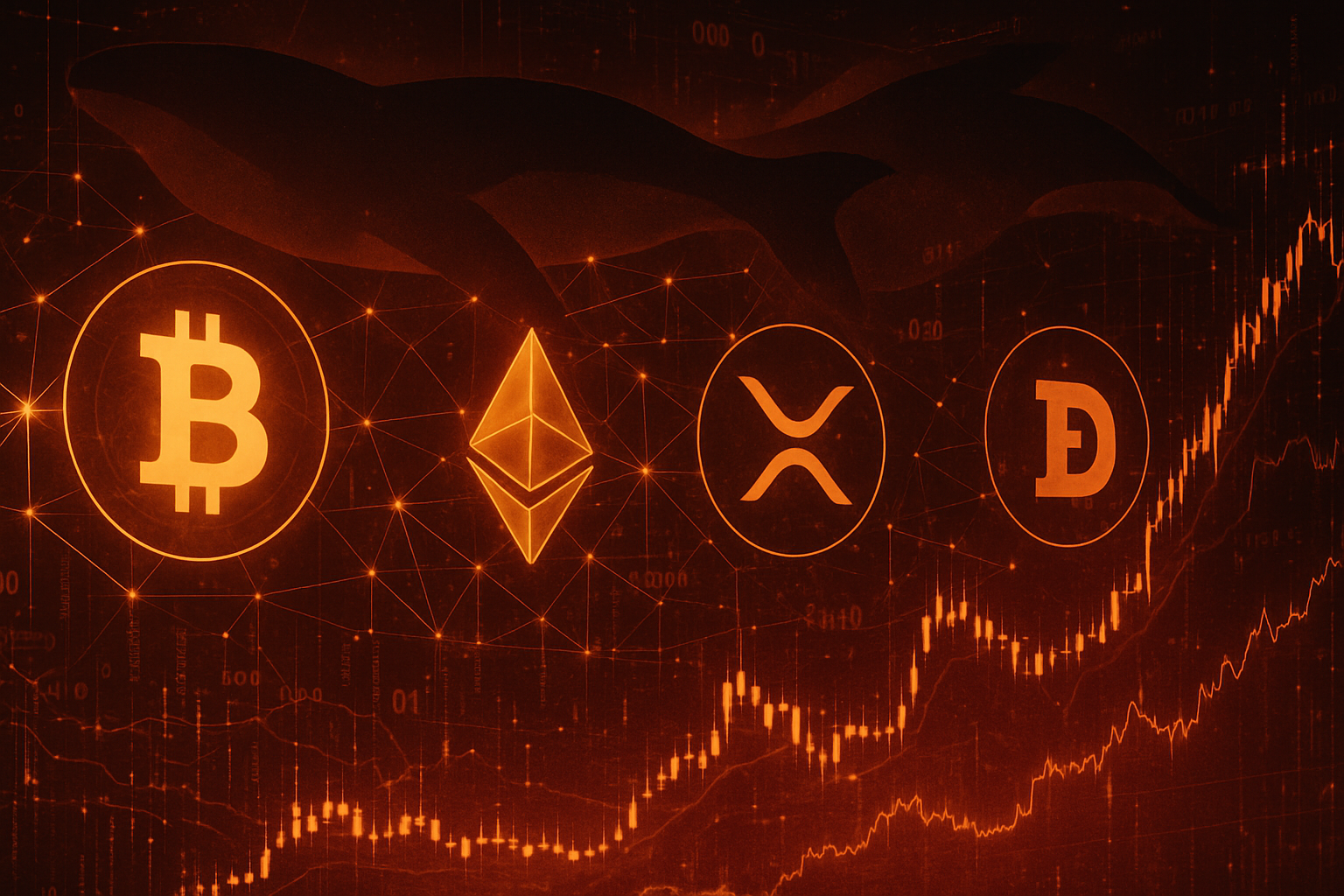
  • Crypto Whales Unleash Volatility: Bitcoin, Ethereum, XRP, and Dogecoin Grapple with Massive Price Swings

    Crypto Whales Unleash Volatility: Bitcoin, Ethereum, XRP, and Dogecoin Grapple with Massive Price Swings

    October 22, 2025 – The cryptocurrency market has been reeling from a series of significant "whale movements" over the past few weeks, culminating in a dramatic market crash on October 11, 2025. These large-scale transactions by influential holders have sent shockwaves through Bitcoin (BTC), Ethereum (ETH), XRP, and Dogecoin (DOGE), triggering substantial price drops and igniting fierce debates about market stability and the immense power wielded by a select few.

    The immediate aftermath of the October 11 crash saw Bitcoin plummet to $105,262, with Ethereum experiencing similar turbulence. This sudden downturn, reportedly catalyzed by news of new tariffs, was exacerbated by strategic actions from an unidentified crypto whale who allegedly profited over $160 million by opening massive short positions on BTC and ETH just hours before the market capitulated. This incident has vividly underscored the outsized influence of large holders, demonstrating their capacity to trigger widespread panic and fundamentally alter market trajectories, impacting not just price but also investor confidence and the broader perception of crypto's maturity.

    Market Impact and Price Action

    The period leading up to and following October 11, 2025, has been a rollercoaster for major cryptocurrencies. Bitcoin, after reaching record highs earlier in the year, saw its price sharply corrected to $105,262 on October 11. This was partly driven by a surge in inflows from whale wallets (holding over 1,000 BTC) to exchanges, with 17,184 BTC sent on October 15 alone—the highest daily inflow for the month. Such movements typically signal an intent to sell or hedge, adding significant selling pressure. On October 22, 2025, further pressure mounted as a prominent whale transferred 5,252 BTC (approximately $588 million) to major exchanges like Coinbase (NASDAQ: COIN), Binance, and Kraken, hinting at potential liquidation.

    Ethereum's price action mirrored Bitcoin's volatility. While mid-July to early October saw aggressive whale accumulation, propelling ETH from $2,600 to over $4,700, the October 11 crash halted this momentum. Recent data from October 21-22, 2025, shows a net inflow of 2,000 ETH ($7.70 million) to Binance, alongside a significant sale of 6,237 ETH (approximately $23.95 million) by a whale at an average price of $3,840. These movements highlight the delicate balance between accumulation-driven rallies and panic-induced sell-offs, with large transactions capable of swiftly altering short-term liquidity and price direction.

    XRP has also been under considerable pressure. Following consistent whale outflows exceeding $50 million daily since late September, its price declined from $3.40 to around $2.71. The period from October 1st to 17th, 2025, witnessed a sharp rise in XRP deposits to Binance, peaking on October 11th with 43,000 whale-to-exchange transactions. These large-scale transfers, indicating whales preparing to liquidate holdings or mitigate risk, directly correlated with XRP's drop from above $3 to the $2.3-$2.6 range. Despite this, a silver lining emerged as the number of addresses holding over 10,000 XRP reached an all-time high, suggesting a long-term accumulation strategy by some large investors.

    Dogecoin, despite experiencing intense whale accumulation in late summer and early October—with billions of tokens amassed and 910 million DOGE (worth $250 million) added after a 30% correction in late September—has not been immune to whale-driven volatility. While sustained buying by whales between 10 million and 100 million DOGE wallets provided a price floor, the high DOGE balance on exchanges (a large portion of supply readily available for sale) served as a warning. Historical patterns from April and December 2024, where similar peaks preceded significant corrections of 55% and 65% respectively, indicate that even strong accumulation can be offset by large sell-offs when whales decide to take profits, leading to substantial price drops for retail investors.

    Community and Ecosystem Response

    The recent whale movements and subsequent market downturn have ignited a firestorm across crypto social media platforms and forums. On Crypto Twitter, the sentiment has been a mix of frustration, fear, and cautious optimism. Many retail investors expressed anger at the perceived manipulation by whales, with hashtags like #WhaleWatch and #CryptoCrash trending. Influencers and thought leaders have weighed in, with some warning against panic selling and advocating for a long-term perspective, while others have criticized the lack of transparency and regulation around large-scale market movements.

    Reddit communities, particularly r/CryptoCurrency and subreddits dedicated to specific coins, saw extensive discussions about the market's vulnerability. There's a palpable sense of unease regarding the concentration of wealth and its potential for destabilization. While some users highlighted the "buy the dip" strategy adopted by certain whales post-October 11 as a sign of underlying strength, others voiced concerns about the fairness of a market so heavily influenced by a few players. The broader Web3 ecosystem, including DeFi protocols and NFT projects, has also felt the ripple effects. Liquidations in DeFi lending platforms increased, and trading volumes for NFTs saw a temporary dip as investors pulled back from riskier assets, underscoring the interconnectedness of the crypto market.

    What's Next for Crypto

    The short-term implications of these whale movements suggest continued volatility. The strategic "buy the dip" behavior by some whales post-October 11, coupled with significant inflows into cold storage and the creation of new whale wallets for Bitcoin, could indicate a belief in a potential market bottom and future appreciation. However, the consistent exchange inflows for XRP and recent ETH sales suggest that selling pressure might persist for these assets as whales continue to rebalance portfolios or take profits.

    In the long term, these events highlight the ongoing maturation of the crypto market. Potential catalysts to watch include further institutional adoption, particularly with the continued absorption of ETH by institutional ETFs, which could provide more stable demand. Regulatory developments, especially concerning market manipulation and transparency, will also be crucial. For projects and investors, strategic considerations should include diversifying portfolios, understanding on-chain metrics to anticipate large movements, and focusing on projects with strong fundamentals that can withstand whale-induced volatility. Possible scenarios range from a sustained recovery driven by renewed institutional and whale accumulation to further consolidation if selling pressure outweighs buying interest, with the latter being more likely if global economic uncertainties persist.

    Bottom Line

    The recent whale movements, particularly around the October 11, 2025 market crash, serve as a potent reminder of the inherent volatility and concentrated power within the cryptocurrency ecosystem. For crypto investors and enthusiasts, the key takeaway is the necessity of vigilance and a deep understanding of market dynamics beyond just price charts. Whale activities, whether accumulation or distribution, are powerful indicators of market sentiment and potential future direction.

    The long-term significance of these events lies in their contribution to the ongoing narrative of crypto market maturity. While the influence of large holders remains undeniable, the market's resilience, demonstrated by the "buy the dip" strategies, suggests an underlying strength and belief in the technology. As crypto adoption continues to grow, increased liquidity and broader participation might dilute the impact of individual whales over time. Investors should closely monitor on-chain metrics, exchange flows, and significant wallet movements. Key dates and events, such as upcoming regulatory announcements or major institutional investment reports, will be crucial metrics to watch as the market navigates these powerful currents.


    This article is for informational purposes only and does not constitute financial or investment advice. Cryptocurrency investments carry significant risk.

  • Standard Chartered’s Bold Bitcoin Call: A Dive Below $100K – Last Chance or Lingering Bear?

    Standard Chartered’s Bold Bitcoin Call: A Dive Below $100K – Last Chance or Lingering Bear?

    In a move that sent ripples through the cryptocurrency markets, Standard Chartered (LON: STAN), a prominent multinational banking and financial services company, predicted in mid-October 2025 that Bitcoin (BTC) could briefly dip below the psychological $100,000 mark. This forecast, delivered by the bank's head of digital assets research, Geoff Kendrick, came on the heels of Bitcoin's impressive ascent to an all-time high of $126,000 on October 6, 2025, before a sharp downturn saw it trade around $108,000, having briefly touched $104,000.

    The prediction, while seemingly bearish in the short term, was notably framed as a significant "buying opportunity" and potentially "the last time Bitcoin is EVER below 100k." This nuanced stance immediately sparked intense debate across the crypto ecosystem, highlighting the delicate balance between short-term volatility and long-term conviction that characterizes the digital asset space. For many, it underscored Bitcoin's growing maturity and its increasing susceptibility to traditional macroeconomic headwinds, even as institutional players like Standard Chartered continued to project aggressive long-term price targets.

    Market Impact and Price Action

    The period leading up to and immediately following Standard Chartered's prediction was characterized by extreme volatility. Bitcoin's journey from its October 6 peak of $126,000 to the $104,000-$108,000 range by mid-October was swift and brutal. This sharp correction was primarily triggered by escalating U.S.-China trade tensions, with U.S. President Donald Trump's threat of 100% tariffs on Chinese imports sparking a broad sell-off across global risk assets. This culminated in a historic $19 billion market liquidation event around October 10-11, the largest in crypto history, dwarfing previous crashes.

    Trading volumes surged during this tumultuous period. While a massive $19 billion liquidation occurred over two days, Bitcoin's 24-hour trading volume on October 22 still registered a significant $61.34 billion, reflecting persistent market engagement despite the price dip. Liquidity conditions tightened around the liquidation event due to major providers withdrawing capital, exacerbating the sell-off. U.S. Bitcoin spot Exchange-Traded Funds (ETFs) initially experienced net outflows, with $94 million on October 16 and $40.47 million on October 20. However, a significant rebound in institutional confidence was observed, with Bitcoin ETFs recording $266 million in inflows on October 22, indicating that institutional investors were actively "buying the dip."

    From a technical analysis perspective, Bitcoin found crucial buying interest near key support levels, particularly around $108,000, $107,500, and $103,500, with the $100,000 and $93,000 marks identified as stronger psychological and structural supports. Resistance levels were noted between $111,000-$113,000 and $114,000. While Bitcoin dipped below its 50-day Exponential Moving Average (EMA), signaling a short-term lack of bullish momentum, it had successfully reclaimed the 200-day EMA and the crucial 50-week moving average, which has historically acted as a robust support since early 2023. The Market Value to Realized Value (MVRV) ratio dipping below its 365-day moving average also historically points to a potential price bottom, setting the stage for future rallies. This pattern echoes past events, such as the September 2017 dip, which preceded strong Q4 rallies, and other MVRV ratio drops that consistently led to significant upward trends.

    Community and Ecosystem Response

    The crypto community's reaction to Standard Chartered's prediction and the subsequent market correction was a fascinating blend of caution and conviction. The broader market sentiment, as gauged by the Fear and Greed Index, plummeted to 29, indicating "fear" among traders. This reflected a natural apprehension as Bitcoin approached the critical $100,000 threshold.

    However, a dominant "buy the dip" narrative quickly permeated social media platforms like Twitter and Reddit. Many users, echoing Standard Chartered's long-term optimism, viewed a sub-$100,000 Bitcoin as a rare, potentially once-in-a-lifetime accumulation opportunity. Community polls, such as those on CoinMarketCap, revealed that a substantial 82% of investors maintained a bullish outlook for Bitcoin despite the immediate price volatility. Crypto influencers largely aligned with this sentiment. Prominent figures like Michael Saylor, CEO of MicroStrategy (NASDAQ: MSTR), whose company recently acquired 168 BTC at an average price of $112,051, publicly advocated for accumulating Bitcoin during such dips. Mike Novogratz, CEO of Galaxy Digital (TSX: GLXY), also suggested Bitcoin would likely hold above the $100k support level. Influencers frequently contextualized the market movements within broader macroeconomic factors, such as the U.S.-China trade tensions and anticipated Federal Reserve rate cuts, which were seen as future catalysts for recovery. The observation of capital rotation from gold to Bitcoin during market uncertainty further solidified the view of Bitcoin as a high-beta alternative hedge.

    While the $19 billion liquidation event likely led to increased liquidations within DeFi lending protocols and a temporary slowdown in the highly speculative NFT market, the broader Web3 ecosystem remained largely resilient. The underlying confidence in Bitcoin's long-term trajectory, evidenced by sustained institutional interest and ETF inflows, prevented widespread panic or a fundamental questioning of Web3 initiatives. The prevailing sentiment was that this was a temporary shake-out rather than a structural flaw in the digital asset space.

    What's Next for Crypto

    Standard Chartered's prediction, despite its short-term bearish tone, ultimately reinforced a profoundly bullish long-term outlook for Bitcoin. The bank's head of digital assets research, Geoff Kendrick, firmly maintained his year-end 2025 target of $200,000 for Bitcoin, with an even more ambitious long-term projection of $500,000 by 2028. This suggests that any dip below $100,000 would be fleeting, serving as a transient phase before a significant rebound.

    Several potential catalysts are expected to fuel this recovery and subsequent rallies. Continued robust inflows into Bitcoin spot ETFs are seen as a primary driver, indicating sustained institutional adoption and demand. Expectations of the Federal Reserve lowering interest rates in the near future are anticipated to create a more favorable macroeconomic environment for risk assets like Bitcoin. Furthermore, the observed "gold-to-Bitcoin" rotations, where investors pivot from traditional safe-havens to Bitcoin during market shifts, could provide additional tailwinds. Technically, the consistent holding of the 50-week moving average as a strong support since early 2023 provides a solid foundation for upward momentum.

    For investors, the strategic consideration is clear: a dip below $100,000 would represent a significant buying opportunity. The most likely scenario involves a brief period of price consolidation or a quick wick below $100,000, followed by a strong rebound driven by institutional accumulation and improving macroeconomic conditions. The market's increasing maturity and institutional influence, as evidenced by the changing dynamics compared to the 2024 halving cycle, suggest a more measured but potentially stronger recovery.

    Bottom Line

    Standard Chartered's prediction of Bitcoin briefly dropping below $100,000 in mid-October 2025 served as a potent reminder of the inherent volatility in the cryptocurrency markets, even as it highlighted Bitcoin's growing integration into traditional finance. For crypto investors and enthusiasts, the key takeaway is the consistent long-term bullish outlook from major financial institutions, despite short-term price corrections driven by macroeconomic factors like U.S.-China trade tensions.

    The long-term significance of this event lies in Bitcoin's continued journey towards becoming a mature asset class. The "buy the dip" mentality, coupled with strong institutional ETF inflows and reaffirmations of high price targets, indicates a deep-seated confidence in Bitcoin's fundamental value and future appreciation. This resilience, even in the face of a historic $19 billion liquidation event, underscores Bitcoin's growing robustness and its role as an alternative store of value.

    Looking ahead, important metrics to monitor include the volume of Bitcoin ETF inflows, announcements from the Federal Reserve regarding interest rates, and Bitcoin's ability to hold key technical support levels, particularly around the $100,000 mark and its 50-week moving average. While short-term fluctuations are inevitable, the prevailing sentiment from both traditional finance giants and crypto thought leaders points towards a continued trajectory of adoption and significant price appreciation for Bitcoin in the coming months and years.


    This article is for informational purposes only and does not constitute financial or investment advice. Cryptocurrency investments carry significant risk.

  • Hong Kong Greenlights First Spot Solana ETF, Outpacing US in Crypto Innovation Race

    Hong Kong Greenlights First Spot Solana ETF, Outpacing US in Crypto Innovation Race

    Hong Kong, October 22, 2025 – In a landmark move poised to reshape the global cryptocurrency investment landscape, Hong Kong's Securities and Futures Commission (SFC) has officially approved the region's first spot Solana (SOL) Exchange-Traded Fund (ETF). The approval, announced today, positions Solana as the third cryptocurrency, following Bitcoin (BTC) and Ethereum (ETH), to receive spot ETF status in the city. This decisive action by Hong Kong further cements its ambition as a leading global crypto hub and notably places it ahead of the United States in offering a regulated investment product for the high-performance blockchain.

    The newly approved ETF, spearheaded by China Asset Management (Hong Kong) (ChinaAMC), is scheduled to commence trading on the Hong Kong Stock Exchange (HKEX) on Monday, October 27, 2025. It will offer investors exposure to Solana's native token across multiple currency counters: Hong Kong dollars (ticker 03460), Chinese yuan (83460), and US dollars (9460), with an estimated minimum investment of approximately US$100. The fund is designed to track the performance of SOL by directly holding the token, with OSL Exchange serving as the virtual asset trading platform. This development is being hailed by the crypto community as a significant step towards mainstream institutional adoption, promising to unlock new avenues for capital inflow and validate Solana's growing prominence in the digital asset ecosystem.

    Market Impact and Price Action

    The immediate market reaction to the announcement of Hong Kong's spot Solana ETF has been a blend of nuanced price action and a dramatic surge in underlying market activity. While Solana's (SOL) price experienced some initial volatility today, largely continuing a short-term downtrend and holding around the $180-$185 support level, the broader market metrics tell a more compelling story. Data indicates a substantial 40-46.73% increase in SOL trading volume within 24 hours of the news, coupled with a 15% increase in open interest for Solana futures.

    This dynamic suggests a classic "buy the rumor, sell the news" scenario for immediate price movements, where some investors may have realized profits on earlier speculative positions. However, the explosion in trading volume and open interest unequivocally points to a significant influx of capital and heightened investor interest in Solana as an asset class. The ability of SOL to maintain its critical support levels amidst this volatility further underscores underlying strength and conviction from institutional players and long-term holders.

    Comparing this to past crypto ETF approvals, such as the initial spot Bitcoin and Ethereum ETFs in the US and other jurisdictions, a similar pattern often emerges where the immediate price pump might be modest or even negative, but the long-term institutional inflows and increased liquidity prove to be substantial. JPMorgan analysts, for instance, anticipate approximately $1.5 billion in net inflows into Solana ETFs during their first year, building on existing inflows into Solana ETPs in other markets. This institutional validation from a major financial hub like Hong Kong is expected to bolster Solana's liquidity, potentially reducing its inherent volatility over time and attracting a broader base of traditional investors.

    Community and Ecosystem Response

    The Solana community and the broader crypto ecosystem have responded with widespread celebration and optimism to Hong Kong's pioneering approval of a spot Solana ETF. On social media platforms like X (formerly Twitter) and Reddit, sentiment is overwhelmingly positive, with discussions centering on the legitimization of Solana as an asset class and the potential for a new wave of capital inflow into the ecosystem. Many users and prominent crypto influencers are highlighting this as a strong validation for SOL and the wider digital asset space, drawing parallels to the transformative impact of Bitcoin and Ethereum ETF approvals.

    Crypto thought leaders are emphasizing how this ETF opens doors for traditional finance investors to gain exposure to Solana without the complexities of direct asset management. This increased accessibility is expected to foster greater institutional adoption and accelerate Solana's integration into mainstream financial portfolios. Discussions also revolve around anticipated price speculation, with many predicting a bullish trend for SOL in the mid to long term, driven by this new regulated investment vehicle.

    The ripple effects are expected to extend throughout Solana-related DeFi protocols, NFT projects, and Web3 applications. The influx of new capital from institutional investors via the ETF could indirectly lead to increased liquidity and Total Value Locked (TVL) within Solana's DeFi ecosystem. This could manifest as higher demand for Solana-based lending protocols, decentralized exchanges (DEXs), and other financial applications. Furthermore, a general bullish sentiment around Solana often translates to increased activity in its NFT market, potentially boosting trading volumes and floor prices for popular collections. Enhanced visibility and a healthier ecosystem are also likely to attract more developers, driving innovation and growth across Solana's Web3 applications, including gaming, social platforms, and decentralized autonomous organizations (DAOs).

    What's Next for Crypto

    Hong Kong's approval of the spot Solana ETF on October 22, 2025, marks a pivotal moment, signaling a maturation of the crypto market beyond just Bitcoin and Ethereum. In the short term, this move is expected to attract significant institutional capital into Solana, enhancing its liquidity and potentially stabilizing its price volatility over time. For other altcoins, the Hong Kong Solana ETF sets a powerful precedent, suggesting that regulatory comfort is expanding. It validates the potential for other large-cap networks to achieve spot ETF status, accelerating the pipeline for such products and offering investors greater diversification opportunities within their crypto portfolios.

    In the long term, this development will accelerate institutional adoption of Solana globally and could pressure other regulators, particularly the US Securities and Exchange Commission (SEC), to expedite their review of altcoin ETFs. Hong Kong's proactive and clear regulatory approach, which emphasizes a compulsory licensing system for Virtual Asset Service Providers (VASPs) and distinguishes between security, utility, and commodity tokens, stands in stark contrast to the US regulatory landscape. While the US has approved spot Bitcoin and Ethereum ETFs, approvals for other altcoin ETFs have faced delays and regulatory uncertainty. Hong Kong's "first-mover edge" in altcoin ETFs underscores its strategic positioning to become the global benchmark for cryptocurrency hubs.

    Potential future catalysts for the broader crypto market include continued altcoin ETF approvals, especially in the US, for tokens like XRP, Litecoin, and Cardano, which could unlock billions in new capital. Favorable regulatory shifts globally, coupled with macroeconomic factors such as expected Federal Reserve interest rate cuts in late 2025 and 2026, could create a conducive "risk-on" environment for digital assets. Technological innovations, particularly the convergence of artificial intelligence (AI) and blockchain, the evolution of Decentralized Finance (DeFi), and the growing tokenization of real-world assets (RWA), are also expected to redefine the crypto ecosystem and drive significant growth.

    For projects, strategic considerations should focus on scalability, regulatory compliance, and continued innovation to meet the demands of institutional capital. Investors, on the other hand, should prioritize thorough research, diversification, and a long-term perspective, while closely monitoring ETF inflows and global regulatory developments. Asia, already accounting for over 60% of worldwide crypto users, is poised to solidify its market leadership, with Hong Kong potentially emerging as the premier regulated hub, attracting institutional capital and fostering innovation, further driving an "eastward flow" of liquidity.

    Bottom Line

    Hong Kong's greenlight for the first spot Solana ETF is a monumental step, offering key takeaways for crypto investors and enthusiasts alike. It represents a significant leap in increasing accessibility and driving mainstream adoption for Solana, providing a regulated and familiar pathway for both institutional and retail investors to gain exposure. This institutional validation from a major financial hub underscores growing confidence in Solana's robust technology and its potential as a diversified asset class, extending investment opportunities beyond Bitcoin and Ethereum.

    The long-term significance of this approval cannot be overstated. It provides a crucial regulated conduit for traditional finance to engage with the high-performance Solana blockchain, signaling a robust and growing institutional acceptance of digital assets. JPMorgan's projection of over $1.5 billion in first-year inflows for Solana ETFs highlights the potential for enhanced liquidity, reduced volatility, and accelerated development within Solana's burgeoning ecosystem of DeFi protocols, NFT projects, and Web3 applications. This strategic move aligns Hong Kong with other progressive jurisdictions and sets a global precedent for altcoin institutionalization.

    This development also vividly illustrates the evolving global regulatory environment, with Hong Kong demonstrating a proactive and welcoming stance towards digital asset innovation under a supervised framework. This contrasts sharply with the US, where regulatory caution has historically slowed the approval of similar products. Hong Kong's leadership in launching spot crypto ETFs is expected to exert additional pressure on the US SEC to expedite its own approvals for Solana and other altcoin ETFs, potentially accelerating a broader shift in global crypto policy.

    Important dates, events, or metrics to monitor moving forward:

    • October 27, 2025: The official launch and commencement of trading for the ChinaAMC Solana ETF (HKEX: 03460, 83460, 9460) on the Hong Kong Stock Exchange.
    • ETF Trading Volumes and Net Inflows: Closely monitor these metrics for insights into actual investor demand and the rate of institutional adoption.
    • Solana (SOL) Price Performance: Observe SOL's ability to hold key support levels and break through resistance, potentially towards new highs.
    • US SEC Decisions: Keep a close watch on any announcements from the US SEC regarding spot Solana ETF applications, as Hong Kong's move may influence their timeline.
    • Solana Ecosystem Growth: Monitor the continued development of Solana's DeFi, NFT, and Web3 sectors, which will likely benefit from increased capital inflow.

    This article is for informational purposes only and does not constitute financial or investment advice. Cryptocurrency investments carry significant risk.

  • T. Rowe Price Ignites Institutional Crypto Race with Active ETF Filing

    T. Rowe Price Ignites Institutional Crypto Race with Active ETF Filing

    Baltimore, MD – October 22, 2025 – In a move set to send ripples across both traditional finance and the burgeoning digital asset landscape, T. Rowe Price (NASDAQ: TROW), a global investment management firm renowned for its active management strategies, officially filed with the U.S. Securities and Exchange Commission (SEC) today for its first-ever cryptocurrency-focused exchange-traded fund (ETF). The proposed "T. Rowe Price Active Crypto ETF" aims to offer investors actively managed exposure to a diversified basket of digital currencies, marking a significant step for a firm of its stature into the crypto ecosystem.

    The filing, an S-1 registration statement, signals a strong conviction from one of the world's largest asset managers in the long-term viability and growth potential of digital assets. While T. Rowe Price executives have remained tight-lipped on official public statements as of the filing date, a company spokesman indicated the fund's intention to employ fundamental, valuation, and momentum factors in its asset selection. This strategic entry by a traditional finance behemoth into the actively managed crypto ETF space is poised to accelerate the institutional adoption narrative, potentially paving the way for a new wave of capital and legitimacy in the digital asset market.

    Market Impact and Price Action

    Given that the filing for the "T. Rowe Price Active Crypto ETF" occurred on October 22, 2025, the immediate market reaction is still unfolding and largely speculative. Unlike a direct approval, a filing typically elicits a more measured response, though the significance of the firm involved can still generate considerable buzz. Initial indications suggest a cautious but positive sentiment building across major cryptocurrencies like Bitcoin (BTC) and Ethereum (ETH), which are expected to be among the ETF's core holdings.

    While specific, definitive price movements directly attributable to this specific filing are still being observed, the broader market context of institutional interest generally acts as a bullish catalyst. Past instances of major financial institutions announcing crypto-related products or services have often been met with upward price pressure and increased trading volumes for leading digital assets. The potential for a large, actively managed fund to allocate capital across multiple cryptocurrencies could establish new support levels and introduce greater liquidity into these markets over time. Analysts are closely watching trading volumes and order books for any early signs of institutional accumulation or increased retail interest spurred by this news. The actively managed nature of the fund, with its flexibility to hold between five and fifteen crypto assets including Bitcoin, Ethereum, Solana (SOL), and XRP, suggests that its future capital deployment could create sustained buying pressure across a diversified portfolio of digital assets, rather than just a singular token.

    Community and Ecosystem Response

    The crypto community, ever vigilant for signs of mainstream validation, has reacted with a mix of excitement and anticipation to T. Rowe Price's filing. Social media platforms, particularly Crypto Twitter and Reddit, are abuzz with discussions highlighting the potential for increased capital inflows and legitimacy that such a traditional finance player brings. Influencers and thought leaders within the space are largely framing this as a significant win for institutional adoption. Eric Balchunas, a senior ETF analyst at Bloomberg, notably described T. Rowe Price's move as a "semi-shock," underscoring the unexpected yet impactful nature of their entry.

    The sentiment generally leans positive, with many viewing this as further evidence of cryptocurrencies' inevitable integration into the global financial system. While there hasn't been an immediate, direct impact on specific DeFi protocols or NFT projects, the broader narrative of institutional embrace is inherently beneficial. It signals a growing comfort level among sophisticated investors with the underlying technology and asset class, which could indirectly bolster confidence in related Web3 applications and decentralized finance ecosystems. The move by a top-five active manager like T. Rowe Price is seen as a strong endorsement, potentially drawing in other hesitant institutional players and retail investors who have been waiting for more regulated and familiar investment vehicles.

    What's Next for Crypto

    The filing by T. Rowe Price marks a crucial inflection point for the crypto market, signaling a deepening of institutional engagement. In the short term, the market will closely monitor the SEC's review process, which can be protracted and subject to regulatory scrutiny. Any positive or negative signals from the SEC regarding this filing, or other similar applications, will likely influence market sentiment. Should the ETF gain approval, it could unlock a significant new channel for traditional investors to gain exposure to digital assets without directly managing private keys or navigating complex crypto exchanges.

    Long-term implications are even more profound. T. Rowe Price's entry into actively managed crypto ETFs could spark a "land rush" among other traditional asset managers, leading to a proliferation of similar products. This competition could drive innovation in crypto investment products, improve fee structures, and further normalize digital assets within mainstream portfolios. For crypto projects and investors, this means a potential increase in demand for established, liquid assets, and a greater emphasis on regulatory compliance and robust infrastructure. The strategic consideration for projects will be to ensure they meet the due diligence standards required by large institutional investors. Potential catalysts to watch include further clarity from the SEC on crypto regulations, the approval of this and other pending spot crypto ETFs, and the continued development of institutional-grade custody solutions.

    Bottom Line

    T. Rowe Price's filing for an actively managed cryptocurrency ETF is a landmark event, underscoring the accelerating trend of institutional adoption in the digital asset space. For crypto investors and enthusiasts, the key takeaway is the continued maturation and legitimization of the asset class. The involvement of a firm with T. Rowe Price's reputation and scale lends significant credibility and could attract a fresh wave of capital from institutional and retail investors who prefer regulated, traditional investment vehicles.

    The long-term significance cannot be overstated. This move is not just about a single ETF; it's about the mainstream financial world increasingly acknowledging and integrating cryptocurrencies. It suggests a future where digital assets are a standard component of diversified portfolios, managed by established financial powerhouses. Investors should monitor the SEC's decision on this and other ETF applications, as well as the performance and asset flows into any approved products. This event solidifies the narrative that digital assets are here to stay, evolving from a niche interest to a recognized asset class within the global financial system. The coming months will be critical in observing how this filing progresses and how other financial institutions respond to this bold step by T. Rowe Price.


    This article is for informational purposes only and does not constitute financial or investment advice. Cryptocurrency investments carry significant risk.

  • North Korea’s Billion-Dollar Crypto Heists: A Looming Threat to Global Cybersecurity and Digital Assets

    North Korea’s Billion-Dollar Crypto Heists: A Looming Threat to Global Cybersecurity and Digital Assets

    In a series of increasingly sophisticated and audacious cyberattacks, North Korea has allegedly escalated its state-sponsored cryptocurrency heists, siphoning billions of dollars from digital asset platforms in a relentless campaign to fund its illicit weapons programs. As of October 2025, reports indicate that the reclusive nation has stolen over $2 billion in cryptocurrency this year alone, pushing the cumulative total of known thefts attributed to Pyongyang since 2017 past an alarming $6 billion. The most significant incident, the staggering $1.46 billion theft from Dubai-based cryptocurrency exchange Bybit (BYBIT) in February 2025, has sent shockwaves through the global financial and cybersecurity communities, marking it as the largest crypto heist in history.

    These state-sponsored cybercrimes, primarily orchestrated by the notorious Lazarus Group and its affiliates, represent a critical and evolving threat to the integrity of the crypto ecosystem. The sheer scale and frequency of these attacks not only undermine investor confidence but also highlight significant vulnerabilities in the security frameworks of exchanges and the broader Web3 landscape. The ongoing illicit financing of North Korea's nuclear ambitions through stolen digital assets underscores the urgent need for enhanced international cooperation, robust regulatory measures, and advanced cybersecurity protocols to safeguard the burgeoning digital economy from nation-state adversaries.

    Market Impact and Price Action

    The continuous barrage of North Korean crypto heists, culminating in the record-breaking Bybit theft in early 2025, has introduced a persistent undercurrent of anxiety into the cryptocurrency markets. While direct, immediate price crashes of major cryptocurrencies like Bitcoin (BTC-USD) or Ethereum (ETH-USD) are not always solely attributable to individual hacks, the cumulative effect of such large-scale security breaches erodes investor confidence and amplifies market volatility. The Bybit incident, involving a substantial amount of Ethereum, did not cause a catastrophic market collapse, but it certainly contributed to a cautious sentiment, especially among institutional investors wary of counterparty risk and the security of centralized exchanges.

    Following major incidents, such as the Bybit heist, there is typically an observed increase in withdrawal requests from exchanges as users move funds to self-custodied wallets, impacting exchange liquidity. Trading volumes can become erratic, with a temporary dip in activity as market participants digest the news and reassess risk. While specific technical analysis on individual tokens affected by a heist might show temporary dips, the broader market often reacts with a flight to perceived safety or a general slowdown in new capital inflow. Comparisons to past events, like the 2022 Ronin Bridge hack (attributed to North Korea) or the Mt. Gox collapse, remind the market of the severe consequences of security failures, reinforcing the need for robust security audits and transparent operational practices from all crypto platforms.

    The geopolitical implications of these thefts also weigh heavily on market sentiment. The use of stolen crypto to fund sanctioned regimes creates a perception of an unregulated 'wild west,' potentially inviting stricter governmental oversight and regulatory crackdowns. This regulatory uncertainty can deter mainstream adoption and institutional participation, ultimately dampening long-term growth prospects. The market's resilience, however, has often been demonstrated in its ability to recover from major shocks, suggesting that while the immediate impact might be negative, the long-term trajectory is often dictated by broader adoption trends and technological advancements rather than isolated security breaches.

    Community and Ecosystem Response

    The crypto community's response to North Korea's escalating cyber warfare has been a mix of outrage, vigilance, and a renewed push for enhanced security. On social media platforms like Crypto Twitter and Reddit, discussions frequently revolve around the attribution of these attacks to the Lazarus Group, the sophisticated methods employed, and the perceived vulnerabilities of both centralized exchanges (CEXs) and decentralized finance (DeFi) protocols. Influencers and thought leaders have consistently condemned these actions, emphasizing the need for robust security practices, multi-factor authentication, and the careful vetting of smart contracts.

    Blockchain analytics firms (Chainalysis, Elliptic, TRM Labs) have become frontline defenders, working tirelessly with law enforcement to trace and freeze stolen funds. Their efforts, combined with international cooperation, have led to some successes in recovering portions of stolen assets, albeit a small fraction of the total. The Bybit incident, for example, prompted the exchange to offer bounties to "crypto sleuths," demonstrating a community-driven approach to combating these threats. While DeFi protocols and NFT projects are not directly targeted in the same way centralized exchanges are, the overall sentiment of insecurity can indirectly affect investor confidence across the entire Web3 ecosystem. The perception of a hostile cyber environment can slow down innovation and adoption, particularly for projects that rely heavily on user trust and capital inflow. The broader crypto community continues to advocate for self-custody solutions and greater transparency from platforms, seeing these as crucial steps in mitigating risks posed by nation-state actors.

    What's Next for Crypto

    The persistent threat of North Korean crypto heists casts a long shadow over the future of the digital asset space, necessitating a multi-pronged approach from both the industry and international bodies. In the short term, we can expect a heightened focus on cybersecurity audits, penetration testing, and the implementation of advanced threat detection systems across all major cryptocurrency exchanges and DeFi platforms. Regulatory bodies, particularly in the U.S. and South Korea, are likely to intensify their efforts to sanction crypto mixers and other services used for money laundering, potentially leading to increased scrutiny and enforcement actions against non-compliant entities.

    Looking ahead, the long-term implications include a stronger emphasis on decentralized security models and self-custody solutions. Investors may increasingly favor platforms that demonstrate superior security track records and transparent operational practices. We could also see the development of more sophisticated blockchain forensics tools and AI-driven anomaly detection systems to track and prevent illicit fund movements. Potential catalysts to watch include further international cooperation agreements on cybercrime, new legislative frameworks aimed at combating state-sponsored hacking, and technological advancements in secure multi-party computation and zero-knowledge proofs that could enhance privacy without sacrificing traceability.

    For projects and investors, strategic considerations must include thorough due diligence on platform security, diversifying holdings across different custody solutions, and staying informed about evolving threat landscapes. The ongoing cat-and-mouse game between hackers and security experts will undoubtedly drive innovation, but it also means that vigilance will remain paramount. Possible scenarios range from a continued escalation of cyber warfare, necessitating even more stringent global responses, to a future where advanced security measures and international collaboration significantly reduce the effectiveness of such attacks, paving the way for more secure and trusted digital asset ecosystems.

    Bottom Line

    North Korea's alleged involvement in stealing billions in cryptocurrency represents one of the most significant and evolving threats to the global digital asset ecosystem. For crypto investors and enthusiasts, the key takeaway is the critical importance of cybersecurity, both at the individual level (using strong passwords, 2FA, and self-custody when appropriate) and in evaluating the platforms they interact with. The long-term significance of these events lies in their potential to accelerate the maturation of the crypto industry, forcing platforms to adopt more robust security standards and prompting international bodies to establish more effective frameworks for combating state-sponsored cybercrime.

    While the market has demonstrated resilience, the continuous drain of capital and the geopolitical risks associated with these heists cannot be ignored. Important metrics to monitor include the frequency and scale of future attacks, the effectiveness of international sanctions and law enforcement efforts in recovering funds, and the industry's response in implementing advanced security protocols. Ultimately, the fight against state-sponsored crypto theft is a battle for the integrity and legitimacy of the digital economy. Successfully countering this threat will be crucial for fostering widespread crypto adoption and ensuring a secure future for digital assets.


    This article is for informational purposes only and does not constitute financial or investment advice. Cryptocurrency investments carry significant risk.

  • Crypto Market Echoes 2020-2021 Bull Run: Is BSC Primed for Dominance in the Next Surge?

    Crypto Market Echoes 2020-2021 Bull Run: Is BSC Primed for Dominance in the Next Surge?

    As of October 22, 2025, the cryptocurrency market is buzzing with a potent mix of anticipation and historical resonance. Many seasoned observers and new entrants alike are witnessing trends that eerily mirror the explosive bull run of 2020-2021, a period that saw unprecedented growth and mainstream adoption. The question on everyone's mind is whether history is set to repeat, and if so, which blockchain ecosystem is best positioned to lead the charge. All eyes are increasingly turning to Binance Smart Chain (BSC), which is demonstrating a formidable resurgence, suggesting it could indeed dominate the next major market upswing.

    The 2020-2021 bull run, which commenced in late 2020 and peaked in November 2021, was a pivotal moment for digital assets. It was driven by a confluence of factors: massive monetary stimulus during the COVID-19 pandemic, surging institutional interest from giants like MicroStrategy (NASDAQ: MSTR) and Tesla (NASDAQ: TSLA), and a Cambrian explosion of innovation in Decentralized Finance (DeFi) and Non-Fungible Tokens (NFTs). This period saw Bitcoin (BTC) skyrocket from approximately $8,000 to over $69,000, while the total crypto market capitalization soared to $3 trillion. The current market, fueled by the April 2024 Bitcoin halving, recent spot Bitcoin ETF approvals, and evolving macroeconomic conditions, is exhibiting similar bullish undercurrents, making a potential repeat of this historic trend a critical development for the entire crypto ecosystem.

    Market Impact and Price Action

    The 2020-2021 bull run was a masterclass in market dynamics, characterized by dramatic price appreciation, surging trading volumes, and shifting liquidity. Bitcoin's ascent was phenomenal, marking an 862% increase from January 2020 to its November 2021 peak. Ethereum (ETH), the backbone of DeFi, saw an 895% appreciation in the year leading up to mid-2021, reaching an all-time high of $4,878. Binance Coin (BNB) experienced an even more spectacular rise, jumping from around $12.5 in March 2020 to a historical peak of $690.93 in May 2021, a staggering 9,813% increase. This period also saw centralized exchanges record over $14 trillion in trading volume in 2021, a 689% increase from 2020, with DeFi's Total Value Locked (TVL) exploding past $100 billion.

    Fast forward to October 22, 2025, and the market is showing fascinating parallels, albeit with its own unique flavor. Bitcoin is currently trading around $108,000-$108,569, having recently pulled back from a brief climb to $122,500 earlier in the month due to geopolitical tensions. Ethereum is hovering around $3,800-$3,827.99, after a significant dip from over $4,700. Binance Coin (BNB) is trading between $1,058-$1,082.37, down 10% in the last week, but notably reached $1,305 earlier in October. The total crypto market capitalization stands between $3.76 trillion and $3.83 trillion, with daily trading volumes fluctuating between $156.6 billion and $194 billion. While short-term outflows from US spot Bitcoin and Ethereum ETFs indicate some profit-taking, sustained institutional interest remains a powerful underlying current.

    Expert predictions for late 2025 and early 2026 are overwhelmingly bullish. Bitcoin is widely anticipated to reach $150,000 to $250,000, with some analysts like Anthony Scaramucci and Charles Hoskinson targeting $200,000 and $250,000 respectively. Ethereum is projected to test $4,500-$4,650, potentially pushing towards $9,000 by December 2025 and possibly exceeding $10,000 within the next two years, especially with the anticipated approval of a spot ETH ETF. BNB is predicted to trade between $1,006.90 and $1,266.07 in 2025. The lessons from 2020-2021, particularly the understanding that bull markets are rarely linear and feature significant corrections, are crucial for investors navigating the current landscape. These past movements inform future expectations, suggesting that while volatility is a given, the overarching trend could be significantly upward, driven by institutionalization, technological advancements, and evolving regulatory clarity.

    Community and Ecosystem Response

    During the 2020-2021 bull run, social media platforms like X (formerly Twitter), Reddit, and Telegram were epicenters of crypto discussion, amplifying sentiment and sometimes directly influencing market moves, notably through figures like Elon Musk. The prevailing sentiment was one of widespread optimism and FOMO (Fear of Missing Out), drawing a massive influx of retail investors and pushing crypto into mainstream consciousness. This period also sparked an explosion in the Web3 ecosystem:

    • DeFi: The "DeFi Summer" of 2020 saw Total Value Locked (TVL) in protocols like Compound, Aave, and Uniswap surge from $600 million to over $100 billion, showcasing blockchain's ability to offer innovative financial services.
    • NFTs: The NFT market boomed in 2021, with projects like CryptoPunks and Bored Ape Yacht Club achieving multi-billion-dollar valuations, demonstrating new avenues for digital ownership.

    As of October 2025, the community's sentiment is a complex mix of "fear" (as indicated by the Crypto Fear and Greed Index) and cautious optimism. Many analysts believe the current bull run began in December 2022, with Bitcoin projected to hit $200,000–$250,000 by year-end, driven by continued institutional inflows and favorable regulatory developments like the U.S. government's Financial Innovation and Technology Act. The influx of capital into Bitcoin ETFs, which attracted $2.71 billion in early October 2025, is seen as a repeat of the 2020-2021 playbook.

    Amidst this, Binance Smart Chain (BSC) is experiencing a "quiet takeover" or "Binance supercycle," with strong community backing for its potential dominance in the next bull run. Its current ecosystem and development paint a compelling picture:

    • Robust User Engagement: BSC achieved an all-time high of 3.62 million daily active addresses in October 2025, surpassing previous peaks and demonstrating robust user engagement.
    • Surging TVL and DEX Volume: TVL on BSC has surged by 217% year-to-date, reaching $17.1 billion, while its Decentralized Exchange (DEX) trading volume hit $20.5 billion, significantly outperforming competitors like Solana.
    • Catalytic Influences: Changpeng Zhao (CZ)'s re-engagement on social media in September 2025 coincided with BNB reaching a new all-time high of $1,311, signaling strong ecosystem backing.
    • Funding and Innovation: YZi Labs' $1 billion fund dedicated to BNB ecosystem development, coupled with a proliferation of new token launches (especially meme coins), is fueling innovation and attracting massive trading volumes. The "Binance Life" meme coin, for instance, rapidly achieved a $500 million market cap and drew over 100,000 new traders.
    • Increased Accessibility: Recent listings of BNB on major American exchanges like Coinbase (NASDAQ: COIN) and Kraken are expected to significantly increase its exposure to the American market, fostering greater adoption and trading demand due to its low fees and fast transaction finality.

    While some suggest BNB's most explosive growth days might be behind it, the sustained activity, profitability for retail traders in BSC's meme token markets, and ecosystem expansion point towards another strong rally, potentially pushing BNB towards $3,000.

    What's Next for Crypto

    If the 2020-2021 bull run trend repeats, the short-term implications (2025-2026) for the crypto market include a potential market cap expansion to $8 trillion-$14 trillion, with Bitcoin reaching $150,000-$250,000 and Ethereum potentially hitting $10,000. While volatility and corrections are expected, the long-term outlook points to market maturation, driven by sustainable, institution-led expansion and increasing real-world utility.

    Several catalysts are poised to drive this momentum:

    • Bitcoin Halving: The April 2024 halving continues its historical role as a supply shock catalyst.
    • Spot ETFs: Continued adoption of Spot Bitcoin ETFs and potential approvals for other altcoin ETFs (e.g., Solana, Litecoin, Ripple) could unlock billions in new capital.
    • Regulatory Clarity: Favorable regulatory shifts, such as the 2025 SEC settlement involving XRP and the US Treasury exempting crypto from corporate minimum tax, boost investor confidence.
    • Macroeconomic Factors: Expected Federal Reserve interest rate cuts in late 2025 and 2026, rising US M2 money supply, and a weakening US dollar create a conducive environment for risk-on assets.
    • Technological Innovations:
      • AI Integration: The fusion of AI with blockchain, including AI-powered wallets and automated investment decisions, is rapidly advancing. Binance is actively integrating AI into BSC for fraud detection and smart contract efficiency.
      • Cross-Chain Interoperability and Layer 2 Solutions: Enhanced interoperability and Layer 2 scaling are crucial for improved user experience and reduced congestion.
      • Decentralized Digital Identity (DeID) & Real-World Assets (RWAs): These emerging solutions are bridging traditional finance with the digital economy.

    For projects, strategic considerations include focusing on scalability, regulatory compliance, differentiation, leveraging emerging technologies like AI, and strong community building. Investors should prioritize thorough research, diversification, a long-term perspective, and robust risk management, while monitoring key metrics like ETF inflows and regulatory developments.

    Binance Smart Chain's (BSC) Potential Dominance in the Next Bull Run

    As of October 22, 2025, Binance Smart Chain is exceptionally well-positioned to dominate the next bull run due to its technological advancements, ecosystem growth, and competitive advantages:

    • Technological Edge: BSC offers significantly lower transaction fees ($0.04-$0.10) and higher throughput (285 TPS with 0.75-second block times) compared to Ethereum. Its EVM compatibility facilitates easy DApp migration, and upgrades like Maxwell and Lorentz hard forks, along with parallel chains like opBNB, enhance scalability. The BNB Goodwill Alliance has dramatically reduced sandwich attacks by 95%, boosting security. Binance's AI integration efforts for fraud detection and smart contract efficiency could provide a significant advantage.
    • Explosive Ecosystem Growth: BSC recorded an all-time high of 3.62 million daily active addresses, with daily active users surpassing 4.7 million. Its cumulative DEX volume exceeded $2 trillion, leading all chains, and TVL surged 217% to $17.1 billion year-to-date. Over 5,000 projects are building on BNB Chain, with its ecosystem outperforming others in Q3 2025. BSC is also the leading blockchain for stablecoin transactions, reaching an $11 billion market cap. BNB's native token hit a new all-time high of $1,350, reflecting strong ecosystem health.
    • Competitive Advantages: BSC excels in retail user acquisition, particularly in gaming and micro DeFi, where low fees are paramount. Binance's active support through grants and hackathons, combined with BSC's strategic launch to address Ethereum's scalability issues, solidifies its position.

    While some analyses suggest a shift of meme coin activity to Solana (NASDAQ: SOL) from BSC, recent data from October 2025 strongly contradicts this, showing BSC's DEX volume surpassing Solana's and its TVL surging. BSC's established market position, continuous innovation, and thriving community make it a formidable contender for dominance.

    Bottom Line

    The echoes of the 2020-2021 bull run are undeniable, and as of October 22, 2025, the crypto market appears to be in the midst of, or on the cusp of, another significant upward cycle. For crypto investors and enthusiasts, the key takeaway is that this potential rally is distinctively marked by increasing institutionalization and a maturing regulatory landscape. The April 2024 Bitcoin halving, coupled with the widespread adoption of spot Bitcoin ETFs, has set a robust foundation for what many predict will be a sustained bull market extending into late 2025 or early 2026.

    The long-term significance of this market event for crypto adoption cannot be overstated. It signals a deeper integration into mainstream finance, fostering enhanced trust and stability through clearer regulatory frameworks. Crypto's utility is expanding beyond speculative trading to practical applications like payments, remittances, and real-world asset tokenization, attracting a broader demographic globally. This cycle is poised to solidify cryptocurrencies as a legitimate and indispensable asset class.

    Binance Smart Chain (BSC) is undeniably a frontrunner in this evolving landscape. Its current momentum, evidenced by record-breaking daily active addresses, surging TVL, and dominant DEX volumes, positions it as a powerful contender for market leadership. BNB's new all-time high of $1,311 reflects the market's confidence in its ecosystem. BSC's strategic advantages—low fees, high scalability, EVM compatibility, robust security enhancements, and an active development roadmap including AI integration and gasless transactions—make it highly attractive to both developers and users.

    Important Dates, Events, and Metrics to Monitor:

    • Bull Run Trajectory: Watch for continued bullish momentum into late 2025 and early 2026 for potential market peaks.
    • Regulatory Milestones: Monitor US regulatory clarity, global compliance (e.g., Europe's MiCA by mid-2026), and evolving AML/data governance requirements.
    • Macroeconomic Indicators: Track central bank policies (especially interest rate cuts), the US Dollar Index (DXY), and broader economic health.
    • Key Crypto Market Metrics: Keep an eye on Bitcoin ETF inflows, stablecoin market cap growth, on-chain activity, Bitcoin dominance (potential drop below 62% for altcoin season), and DeFi TVL.
    • BSC-Specific Metrics: Continuously monitor BSC's daily active addresses, TVL, DEX volume, BNB price performance, roadmap implementation (e.g., 1-second block latency, gasless transactions, AI-powered wallets), and decentralization progress (expansion of validator set to 41).

    While BSC faces competition and centralization concerns, its aggressive innovation and strong community support make it a formidable force. Its ability to maintain this momentum, enhance decentralization, and navigate regulatory challenges will be crucial for its long-term claim to dominance in the competitive blockchain space.


    This article is for informational purposes only and does not constitute financial or investment advice. Cryptocurrency investments carry significant risk.

  • Federal Reserve’s Crypto Embrace and Rate Cut Hopes Spark “Explosion” Predictions for XRP, ETH, and ADA

    Federal Reserve’s Crypto Embrace and Rate Cut Hopes Spark “Explosion” Predictions for XRP, ETH, and ADA

    Washington D.C. – October 22, 2025 – A series of pivotal events emanating from the Federal Reserve this October has sent ripples of optimism through the cryptocurrency markets, with analysts now forecasting potential "explosions" for major digital assets like XRP, Ethereum (ETH), and Cardano (ADA). From landmark conferences welcoming DeFi to anticipated interest rate cuts, the U.S. central bank's evolving stance on digital assets is being hailed as a significant bullish catalyst, poised to inject substantial liquidity and institutional interest into the crypto ecosystem.

    The week of October 21, 2025, witnessed the Federal Reserve's "Payments Innovation Conference," where Governor Christopher Waller signaled a new era, explicitly inviting the decentralized finance (DeFi) industry to contribute to the future of U.S. payments. Concurrently, markets are keenly awaiting the Federal Open Market Committee (FOMC) meeting on October 28-29, with widespread expectations of another 25 basis point interest rate cut. These developments, coupled with ongoing discussions around stablecoin regulation and the recent approval of a bank charter for a crypto-focused institution, paint a picture of increasing integration and regulatory clarity, setting the stage for what many believe could be a monumental rally for leading altcoins.

    Market Impact and Price Action

    The Federal Reserve's dovish pivot, marked by an initial rate cut in September 2025 and the anticipated follow-up this month, is widely perceived as a potent stimulant for risk assets, including cryptocurrencies. Historically, such monetary policy shifts have channeled capital into higher-yielding, riskier investments, and analysts are drawing parallels to past cycles where XRP, for instance, has significantly outperformed traditional equities following similar Fed actions. The expectation of multiple rate cuts throughout 2025 could see billions flow into crypto ETF products, further bolstering market liquidity and institutional engagement.

    XRP (XRP), currently trading around $2.49 as of mid-October 2025, is a focal point of intense bullish speculation. Analysts, including a former Goldman Sachs (NYSE: GS) executive, have posited long-term targets as high as $1,000 by 2030, representing an astronomical 31,000% surge. More immediate technical analyses project XRP reaching $4.50-$5.50 over the next six months, with AI models forecasting a range of $5 to $10 by the end of 2025. The primary drivers for this optimism are the expected resolution of Ripple's (XRP) ongoing lawsuit with the U.S. Securities and Exchange Commission (SEC) and the highly anticipated approval of an XRP Exchange-Traded Fund (ETF), which is rumored for October 2025. A breakout above the $3.50 resistance level is seen as a precursor to a potential move towards $5.

    Ethereum (ETH), trading near $3,949 in mid-October, is likewise slated for significant appreciation. Fundstrat CIO Tom Lee projects ETH to rally to $5,500 and potentially hit $12,000 by year-end 2025, citing positive sentiment following the GENIUS Act and the potential for staking-enabled Ethereum ETFs. DeepSeek AI's models predict ETH could "explode" to $15,000 by late 2025, a 280% increase, fueled by its dominance in DeFi and anticipated institutional inflows. Short-term, ETH could target $4,800 to $5,000, with long-term forecasts even reaching $18,000. Regulatory clarity surrounding Ethereum-based Exchange Traded Products (ETPs) and the upcoming Fusaka upgrade in December 2025, aimed at enhancing scalability, are key catalysts underpinning these predictions. Morgan Stanley (NYSE: MS) analysts are also forecasting a 40% surge, potentially pushing ETH to $6,250.

    Cardano (ADA), hovering around $0.6801 in mid-October, is also expected to experience substantial growth. DeepSeek AI forecasts ADA could climb to between $7 and $10 by the end of 2025, a staggering 1,370% surge. Other analysts project targets of $3-$4 for 2025, with longer-term views extending to $5 or more, especially if it overcomes major resistance levels. Crypto Jebb, a prominent analyst, believes ADA could surpass its 2021 all-time high of $3.10 and potentially hit $5 by year-end. Technical indicators like a MACD golden cross and bullish chart patterns suggest a "parabolic breakout" and a potential 30% surge to $1.074. The potential approval of a Cardano ETF, with Polymarket showing an 87% probability of a 2025 launch, is a major driver for institutional interest, despite the SEC having delayed its approval until October 2025, causing some short-term volatility.

    Community and Ecosystem Response

    The crypto community's sentiment is overwhelmingly bullish, buoyed by the Federal Reserve's increasingly pragmatic approach to digital assets. Governor Waller's explicit welcome to the DeFi industry at the Payments Innovation Conference, a sentiment he noted would have been "unimaginable a few years ago," resonated strongly across crypto Twitter and Reddit. This shift is interpreted as a signal of legitimate recognition and potential integration, fostering widespread excitement among developers, investors, and enthusiasts.

    Influencers and thought leaders are amplifying these positive signals, pointing to the confluence of regulatory progress and favorable macroeconomic conditions. The discussions around "skinny master accounts" for fintechs and payment firms, including those dealing with digital assets, suggest a path for greater interoperability and direct access to the Fed's payment systems, which could significantly de-risk operations for many crypto-native businesses. While Federal Reserve Governor Michael Barr maintained a cautious stance on stablecoin risks at D.C. Fintech Week on October 16, emphasizing their role as "pure payment instruments," the overall tone from the Fed is one of cautious exploration rather than outright dismissal. This nuanced approach is seen as a constructive step towards a more mature regulatory framework, which in turn could unlock further institutional capital for DeFi protocols, NFT projects, and Web3 applications built on platforms like Ethereum and Cardano.

    What's Next for Crypto

    The remainder of 2025 and heading into 2026 appears ripe for significant developments in the crypto market. The immediate focus is on the upcoming FOMC meeting on October 28-29, where an anticipated interest rate cut could provide an immediate liquidity injection, potentially triggering a broader market rally. Beyond this, further rate cuts throughout 2025, as suggested by some analysts, would continue to fuel the bullish narrative for risk assets.

    Key catalysts to watch include the final resolution of Ripple's SEC lawsuit, which could set a precedent for other altcoins, and the approval of various crypto ETFs—specifically for XRP, staking-enabled Ethereum, and Cardano. These ETFs are expected to unlock substantial institutional investment, bridging the gap between traditional finance and the digital asset space. Ethereum's Fusaka upgrade in December 2025 is also a critical development, promising enhanced scalability and efficiency, which could further cement its position as the backbone of the decentralized economy.

    Strategic considerations for projects and investors will revolve around adapting to the evolving regulatory landscape. While the U.S. has firmly rejected a Central Bank Digital Currency (CBDC), as evidenced by President Trump's executive order in January 2025, its openness to private crypto innovation, as seen with the OCC's preliminary approval for Erebor Bank (a crypto-focused national bank), signals a clear path for compliant digital asset businesses. The most likely scenario is a continued trend towards greater institutional adoption and regulatory clarity, albeit with ongoing debates on specific aspects like stablecoin backing.

    Bottom Line

    The Federal Reserve's increasingly accommodating stance on private crypto innovation, coupled with an anticipated easing of monetary policy, marks a pivotal moment for the cryptocurrency market. For XRP, Ethereum, and Cardano, the convergence of potential interest rate cuts, advancing regulatory clarity, and the promise of institutional-grade investment vehicles like ETFs presents a compelling case for significant price appreciation, potentially leading to the "explosions" many analysts are predicting.

    The long-term significance of these developments cannot be overstated. The Fed's willingness to engage with DeFi and explore mechanisms like "skinny master accounts" signifies a move towards greater integration of digital assets into the mainstream financial system, fostering broader crypto adoption. While investment in cryptocurrencies carries inherent risks, the current macroeconomic and regulatory environment appears to be aligning favorably for these major altcoins. Investors and enthusiasts should closely monitor the FOMC's decisions on October 28-29, further developments on ETF approvals, and any new statements from regulatory bodies, as these will be crucial metrics in gauging the market's trajectory through the end of 2025 and beyond.


    This article is for informational purposes only and does not constitute financial or investment advice. Cryptocurrency investments carry significant risk.

  • Bitcoin Hyper: A Rising Contender or a Risky Bet in the 2025 Crypto Landscape?

    Bitcoin Hyper: A Rising Contender or a Risky Bet in the 2025 Crypto Landscape?

    As the cryptocurrency market navigates a complex blend of innovation and speculation in late 2025, a new contender, Bitcoin Hyper ($HYPER), has been generating significant buzz. Positioned as a Layer 2 (L2) scaling solution for Bitcoin, the project has successfully concluded its presale, raising over $24 million and attracting considerable attention from retail investors and crypto enthusiasts. While promotional narratives have touted $HYPER as "2025's strongest pick," potentially surpassing established giants like XRP, Pi Network, and Pepe, a closer look reveals a more nuanced picture of high potential intertwined with considerable risk.

    Bitcoin Hyper aims to revolutionize the Bitcoin ecosystem by introducing smart contract capabilities and faster, cheaper transactions through its integration of the Solana Virtual Machine (SVM) and zero-knowledge (ZK) proofs. This ambitious vision addresses long-standing limitations of the Bitcoin network, promising to unlock new use cases from instant global payments to decentralized applications. The immediate market response has been a surge in speculative interest, driven by aggressive marketing and the allure of early-stage gains. However, for the broader crypto ecosystem, Bitcoin Hyper represents a critical test case: can a technically ambitious project with an anonymous team truly carve out a dominant position in a mature, competitive market, or is it another example of presale hype overshadowing fundamental realities?

    Market Impact and Price Action

    Bitcoin Hyper's market journey thus far has been characterized by its presale success and the anticipation surrounding its upcoming Token Generation Event (TGE) and exchange listings, expected in Q4 2025 or Q2 2026. During its presale, the price of $HYPER steadily climbed from an initial $0.0115 to approximately $0.013145. While impressive for an early-stage project, its current market capitalization, reported around $11.58 million based on a circulating supply of 1 billion tokens, places it significantly below top-tier cryptocurrencies. For context, XRP (XRP) boasts a market capitalization exceeding $149.4 billion as of October 21, 2025, firmly establishing it as the third-largest cryptocurrency. Similarly, established meme coins like Pepe (PEPE) command substantial market valuations that dwarf $HYPER's current figures.

    The project's fully diluted valuation (FDV), based on its total supply of 21 billion tokens, is projected to reach $1.2 billion if the price hits $0.0583, highlighting its long-term speculative potential rather than current market dominance. Daily trading volume on Uniswap V2 has been around $7.74 million, indicating active, albeit speculative, interest. Technical analysis at this stage is largely speculative, given its presale status and lack of widespread exchange data. Key support and resistance levels will only emerge post-listing, but the current enthusiasm suggests a high degree of volatility upon its public debut.

    Compared to past events, Bitcoin Hyper's trajectory mirrors many high-profile presale projects that promise significant returns. While some have delivered, many have struggled to sustain momentum post-launch. The challenge for Bitcoin Hyper will be to transition from presale hype to delivering a functional product that justifies its valuation and attracts sustained institutional and retail investment, a hurdle that many technically ambitious projects often fail to clear.

    Community and Ecosystem Response

    Community sentiment surrounding Bitcoin Hyper is largely bifurcated. On one hand, there's considerable "hype about the potential," with a vibrant online presence across platforms like Telegram and X (formerly Twitter). This enthusiasm is fueled by the promise of solving Bitcoin's scalability issues and the attractive, albeit potentially unsustainable, staking rewards (initially up to 5,000% APY, now around 48-50%). Crypto influencers and analysts have frequently highlighted $HYPER as one of the "best new cryptos of 2025," attracting a wave of speculative investors drawn to its low entry point and perceived "parabolic returns." Reports of "massive whale activity" further amplify this sentiment, suggesting significant capital inflow.

    On the other hand, the community also grapples with "scam controversies" and legitimate concerns regarding the project's transparency and long-term viability. The anonymous development team is a significant red flag for many, raising questions about accountability. The absence of a publicly available working product, open-source code, or demos means that the project's technical claims are yet to be proven. While security audits by Coinsult and SpyWolf are cited, one review notes that only the token contract was audited, leaving critical components like staking and bridging contracts unaudited. This mixed sentiment reflects a broader trend in the Web3 space, where innovative concepts often emerge from anonymous teams, but the lack of transparency can erode trust.

    The project's "Pepe-inspired mascot" attempts to blend utility with meme coin branding, appealing to a diverse segment of the crypto community. However, its impact on related DeFi protocols or NFT projects is currently minimal, as the ecosystem is still in its nascent stages. Broader crypto Twitter and Reddit sentiment, while acknowledging the project's buzz, often includes cautionary tales about high-risk presales and the importance of due diligence.

    What's Next for Crypto

    The emergence and reception of Bitcoin Hyper offer several insights into the short and long-term implications for the crypto market. In the short term, the success of its presale underscores the continued appetite for high-risk, high-reward speculative investments, particularly in projects promising to enhance established ecosystems like Bitcoin. This trend suggests that capital will continue flowing into innovative Layer 2 solutions and projects that address core blockchain limitations. The anticipated TGE and exchange listings for $HYPER will be crucial catalysts, determining its initial price stability and broader market acceptance. A strong debut could further fuel speculative interest in similar projects, while a poor performance might temper enthusiasm for unproven ventures.

    In the long term, Bitcoin Hyper represents a strategic consideration for both projects and investors. If it successfully delivers on its technical roadmap—providing a secure, scalable, and functional Bitcoin L2—it could significantly contribute to Bitcoin's utility beyond a store of value. This would validate the growing narrative around Bitcoin's programmability and its potential to host a vibrant dApp ecosystem. However, the anonymous team and the current lack of a working product pose substantial risks. For investors, the strategic consideration lies in balancing the potential for exponential gains against the high probability of failure inherent in such early-stage, speculative ventures. Projects aiming for similar innovation must learn from Bitcoin Hyper's marketing strategies, but also prioritize transparency and demonstrable progress to build sustainable trust.

    Possible scenarios include Bitcoin Hyper becoming a leading Bitcoin L2, attracting significant developer activity and capital, or it could struggle to gain traction post-launch, falling victim to technical challenges, competitive pressures, or a loss of investor confidence due to its opaque team structure. The likelihood of the former hinges heavily on the successful deployment of its mainnet and the security and efficiency of its bridging mechanisms.

    Bottom Line

    For crypto investors and enthusiasts, Bitcoin Hyper (HYPER) presents a quintessential high-risk, high-reward opportunity in the current market. While its vision to enhance Bitcoin's scalability and functionality is compelling, and its presale success is undeniable, it has not, as of October 2025, surpassed established cryptocurrencies like XRP, Pi Network, or Pepe in terms of market capitalization or broad-based investor interest. XRP (XRP) remains a top-tier asset with significant institutional backing, while Pepe (PEPE) holds its niche in the meme coin market, and Pi Network continues to engage a vast user base with its unique mining model.

    The long-term significance of Bitcoin Hyper will depend entirely on its ability to transition from a conceptual project with presale hype to a robust, functional Layer 2 solution. Key takeaways include the importance of due diligence on anonymous teams, the need for a demonstrable product before significant capital allocation, and the understanding that aggressive marketing does not equate to fundamental value.

    Important dates to monitor include its Token Generation Event (TGE) and subsequent listings on major exchanges, which will provide the first true test of its market performance and liquidity. Metrics to watch will be developer adoption, total value locked (TVL) on its L2, and the security audits of its live contracts. Ultimately, while Bitcoin Hyper embodies the innovative spirit of the crypto space, investors should approach it with caution, recognizing the substantial speculative element involved.


    This article is for informational purposes only and does not constitute financial or investment advice. Cryptocurrency investments carry significant risk.