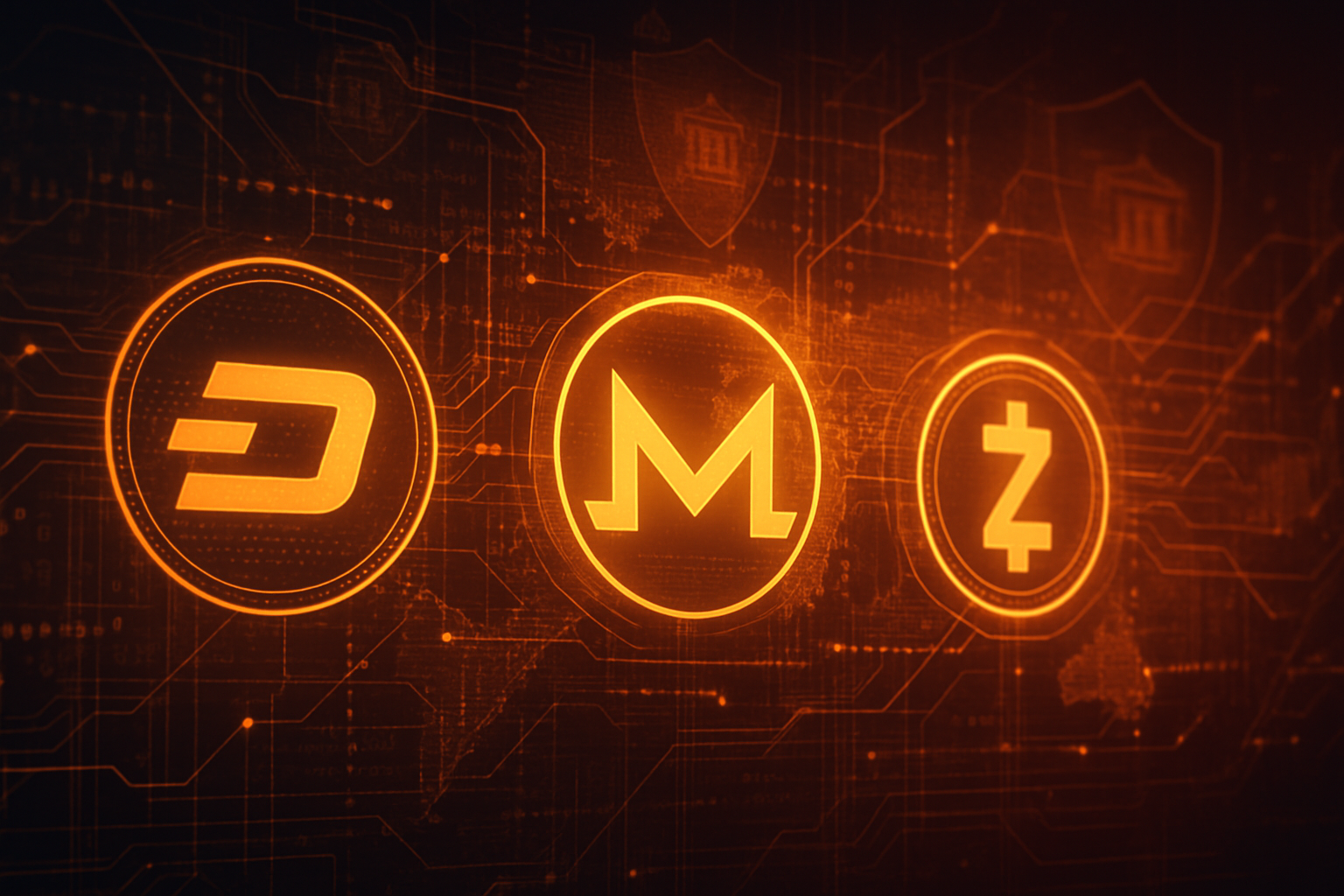
November 11, 2025 – In a significant development for the digital asset landscape, privacy-focused cryptocurrencies have experienced a remarkable resurgence throughout 2025, with their combined market capitalization soaring by approximately 80% to between $23.5 billion and $25 billion by early November. This surge unfolds amidst an increasingly stringent global regulatory environment, highlighting a growing tension between individual financial privacy and governmental calls for transparency. The renewed interest in assets like Monero (XMR), Zcash (ZEC), and Dash (DASH) underscores a fundamental shift in user priorities, as the crypto community seeks refuge from pervasive digital surveillance and centralized control.
This resurgence is not merely a market anomaly; it signifies a deeper re-evaluation of core crypto principles. As mainstream cryptocurrencies become increasingly transparent and susceptible to state-level monitoring, privacy coins are emerging as crucial bastions of financial sovereignty and censorship resistance. Their performance in 2025, often outperforming Bitcoin's (BTC) 27.1% and Ethereum's (ETH) 33.4% gains with a 71.6% rise, signals a robust demand for confidentiality. This trend is set to profoundly impact the future trajectory of the crypto ecosystem, pushing innovation in privacy-enhancing technologies while challenging regulators to reconcile oversight with fundamental digital rights.
Market Impact and Price Action
The market for privacy-focused cryptocurrencies has been nothing short of dynamic in 2025, characterized by significant price movements, surging trading volumes, and shifting liquidity, all against a backdrop of escalating regulatory pressures.
Zcash (ZEC): A Phenomenal Surge Driven by Halving and Institutional Interest
Zcash (ZEC) has led the charge, exhibiting the most dramatic price action among prominent privacy coins. After spending much of 2024 under $40, ZEC's price rocketed by over 500% in less than two months, breaking a multi-year downtrend to reach highs near $374 by late October 2025. By November 10, 2025, ZEC was trading around $518.42, boasting a market cap of $10 billion and a 24-hour trading volume of $3.8 billion, even briefly surpassing Monero in market capitalization. This meteoric rise, which saw ZEC surge over 700% since late September and 1,250% in the last three months, is largely attributed to its second halving event in November 2025, which reduced the block reward from 3.125 ZEC to 1.5625 ZEC. This supply reduction, coupled with growing institutional interest evidenced by Grayscale's (OTCQX: GRSC) increased Zcash holdings and the launch of a Zcash Trust Fund in October 2025, fueled speculative and sustained buying. Trading volume for ZEC surged dramatically, with 24-hour volumes reaching $1.3 billion at its October peak, a 900% increase over its September average. Open interest in ZEC futures also climbed from under $50 million to approximately $306.3 million by late October.
Monero (XMR): Resilience Amidst Regulatory Headwinds
Monero (XMR), often considered the "gold standard" of privacy coins, has also demonstrated significant market resilience in 2025 despite facing considerable regulatory scrutiny and delistings from some exchanges. By May 2025, XMR rose to $353.71, its highest level since 2021, and continued this upward trajectory to reach $470 in November 2025, a price not seen since May 2021. On November 10, 2025, XMR was trading around $386.43 with a market cap of $7.5 billion and a 24-hour volume of $216.4 million. The revival of XMR is linked to bullish chart signals, renewed interest in privacy-focused assets, and spillover demand from Zcash's rally. Monero's mining hashrate reached an all-time high in May 2025, more than doubling since April 2024, indicating strong network fundamentals and miner confidence. However, Monero's market dynamics are heavily influenced by regulatory actions, with several centralized exchanges like Kraken (OTCQX: KRAK) and Binance (BINANCE: BNB-USD) delisting it from certain platforms due to regulatory pressure. This has concentrated XMR's trading volume on fewer, often less accessible exchanges, impacting its mainstream exposure and liquidity.
Dash (DASH): A Privacy Coin with Governance Focus Experiences Significant Rallies
Dash (DASH) has also experienced notable price action in 2025, with significant rallies in June and October. In June 2025, DASH saw an astonishing 150% price surge, climbing from $20 to approximately $50 by month-end, with trading volume surging by 200%. By late October 2025, Dash experienced another impressive rise of over 200%, reaching $47.69 by October 31. On November 11, 2025, Dash rose 14.05% in 24 hours to $84.20, outperforming the broader crypto market, driven by the overall privacy coin rally, new Decentralized Exchange (DEX) integrations, and a technical breakout above key resistance levels. However, by November 10, 2025, Dash, alongside Zcash and Monero, faced a sharp 12% drop in 24 hours due to fears of an impending EU privacy coin ban (effective July 2027) and profit-taking. Historically, Dash reached its all-time high of $1,642 in December 2017, and while its market cap in September 2025 was around $292.29 million, recent rallies have significantly increased it to approximately $889.73 million by early November 2025.
The overall privacy coin market capitalization rose by approximately 80% leading up to early November 2025, signaling a broader resurgence in investor interest. This renewed demand is amplified by increasing global financial surveillance and regulatory crackdowns on traditional cryptocurrencies, such as the US Department of Justice’s seizure of 127,000 Bitcoins (BTC) in October 2025, which highlighted the traceability of non-private assets.
Community and Ecosystem Response
The crypto community's response to the privacy coin resurgence and intensified regulatory scrutiny is a complex mix of advocacy, concern, and adaptation, profoundly influencing the broader Web3 and DeFi landscape.
Social media platforms like Twitter and Reddit are ablaze with discussions, memes, and impassioned arguments. The phrase "privacy is a necessity, not a feature" has become a rallying cry, echoing a sentiment that financial confidentiality is a fundamental right. Google search interest for "crypto privacy" surged in 2025, indicating heightened public awareness. While Monero is frequently discussed for its default privacy and use in peer-to-peer transactions, Zcash's recent rally has been linked to growing concerns over potential government overreach, amplified by an apparent endorsement from Edward Snowden, who called Zcash "the best in this space."
Reactions from crypto influencers and thought leaders further underscore this shift. Arthur Hayes publicly called for "ZEC target $10,000," reflecting bullish sentiment. Vitalik Buterin, co-founder of Ethereum, has "repeatedly endorsed ZKsync" and questioned why more funds aren't directed towards privacy protocols. The legal actions against crypto mixers like Tornado Cash and the sentencing of Samourai Wallet co-founder Keonne Rodriguez in November 2025 have sent "chilling waves" through the privacy community, with #PrivacyIsNotACrime gaining traction as a symbol of resistance against what many perceive as an assault on digital privacy rights.
The regulatory landscape is significantly influencing DeFi and Web3 projects. The underlying technologies of privacy coins, particularly zero-knowledge proofs (ZKPs), are increasingly seen as fundamental to the future of financial privacy. Institutions are actively seeking "compliant privacy" solutions, with Paxos partnering with Aleo to launch a private and compliant stablecoin (USAD), and the Ethereum Foundation establishing a new privacy team. COTI's "programmable privacy" is now integrated into MetaMask, enabling users to handle privacy tokens directly. Experts believe that privacy-focused stablecoins will become standard features, driven by institutional demand for confidentiality in operations like payroll and treasury management. However, the legal actions against crypto mixers have also raised concerns about a "chilling effect" on innovation and developer liability, creating uncertainty for privacy-focused projects.
Technologies Behind Privacy Coins
Privacy-focused cryptocurrencies harness advanced cryptographic techniques to offer unparalleled anonymity and confidentiality. These technologies move beyond mere pseudonymity, obscuring transaction details, sender, and receiver identities.
-
Zero-Knowledge Proofs (ZKPs): zk-SNARKs and zk-STARKs
ZKPs allow one party to prove they know a secret or that a statement is true without revealing any information about the secret itself.- zk-SNARKs (Zero-Knowledge Succinct Non-Interactive Argument of Knowledge): Used by Zcash (ZEC), these enable "shielded transactions" where sender, recipient, and amount are hidden. Zcash's Halo 2 system, implemented in 2022, notably removed the "trusted setup" requirement, enhancing security.
- zk-STARKs (Zero-Knowledge Scalable Transparent Argument of Knowledge): A newer evolution, zk-STARKs are scalable, transparent (no trusted setup), and quantum-resistant. Projects like StarkNet use them to bundle transactions off-chain, increasing throughput while maintaining privacy.
-
Ring Signatures: A cornerstone of privacy in Monero (XMR), ring signatures allow any member of a predefined group to produce a valid signature, making it computationally infeasible to determine the actual signer. When a Monero user sends funds, their signature is blended with several "decoys," making the true sender indistinguishable. Ring Confidential Transactions (RingCT) further obfuscate transaction amounts.
-
Stealth Addresses: These generate distinct, one-time addresses for every transaction, concealing the recipient's identity and transaction history. Monero utilizes stealth addresses to prevent address reuse and make fund tracing difficult. Vitalik Buterin has also proposed a stealth address system for Ethereum.
-
CoinJoin: An anonymization strategy used by Dash (DASH) via its "PrivateSend" feature, CoinJoin combines multiple users' transactions into a single, larger transaction. By mixing inputs and outputs from various users, it breaks the common-input-ownership heuristic, making it difficult to trace individual spending activity.
Legitimate Use Cases for Privacy Coins
Despite regulatory concerns, privacy coins serve several legitimate and growing use cases as of November 2025:
- Protecting Financial Privacy for Individuals: Offering confidentiality similar to cash, allowing individuals to conduct transactions without public record.
- Confidential Business Transactions: Enabling businesses to protect sensitive financial information from competitors and ensure proprietary transaction details.
- Institutional Use Cases and "Regulated Privacy": Financial institutions are exploring these technologies for confidential transfers and shielded pools, aiming for "regulated privacy" that allows for selective disclosure when legally required.
- Integration with Decentralized Finance (DeFi): Enabling private lending, borrowing, and yield generation without publicly exposing entire portfolios.
- Private Payments and E-commerce: Facilitating anonymous payments across peer-to-peer platforms and online services.
- Identity Verification and Authentication: ZKPs allow users to prove they meet requirements without revealing personal data, enhancing security and reducing fraud.
- Supply Chain Management: Verifying product authenticity and data integrity without exposing sensitive internal processes.
- Private Voting Systems: Ensuring voting integrity while maintaining voter anonymity.
- Layer-2 Scaling Solutions: ZKPs are crucial for zk-Rollups, enhancing scalability and privacy on networks like Ethereum by validating transactions off-chain without revealing contents.
Regulatory Scrutiny
Privacy-focused cryptocurrencies are operating under intense global regulatory scrutiny as of November 2025, driven by concerns over money laundering, terrorist financing, and illicit activities.
Delistings Due to Regulatory Pressure: Exchanges globally have increasingly delisted privacy coins. Kraken (OTCQX: KRAK) delisted Monero (XMR) for users in the European Economic Area (EEA) in late 2024, citing upcoming EU MiCA legislation. Binance (BINANCE: BNB-USD) and OKX (OKX: OKB-USD) have taken similar actions. Coinbase (NASDAQ: COIN) has consistently refrained from listing Monero. Overall, 73 exchanges worldwide have delisted privacy coins in 2025, a 43% increase from 2023.
Government Actions and Enforcement: Governments are taking decisive action. In the U.S., prosecutions against crypto privacy tools include the conviction of a Tornado Cash developer and the guilty plea of Samourai Wallet founders in 2025. FinCEN has proposed a "mixer rule" that could label everyday privacy tactics as money laundering. The EU's new Anti-Money Laundering Regulation (AMLR) bans "crypto-asset accounts allowing anonymization of transactions" and prohibits exchanges from listing privacy coins, with rules enforceable by mid-2027. Japan and South Korea have already banned privacy coins on domestic exchanges.
FATF Guidance: The Financial Action Task Force (FATF) continues to drive global regulatory standards. Its June 2025 update emphasized the urgent need for tougher action against virtual asset money laundering risks, noting persistent gaps in supervision. Privacy coins are explicitly included in the FATF's Travel Rule guidance, which mandates information sharing between Virtual Asset Service Providers (VASPs).
MiCA Framework: The EU's Markets in Crypto-Assets (MiCA) regulation, fully operational from 2025 with phased enforcement through 2027, is a landmark framework. It mandates strict compliance, forcing crypto service providers to reconsider support for privacy coins and will prohibit CASPs from offering them. This framework, updated in October 2025, suggests even more stringent compliance for privacy coins.
General Stance of Financial Regulators: Regulators globally maintain a skeptical stance, viewing anonymity features as significant risks to financial integrity, particularly concerning money laundering, tax evasion, and terrorism financing. This has led exchanges to prioritize compliance to avoid penalties. However, a "robust demand" for privacy-centric solutions persists, with users valuing anonymity in an era of increasing digital surveillance. Some projects, like Zcash with its optional transparency, are adapting to be more compatible with regulated environments, aiming for "auditable privacy."
What's Next for Crypto
The future outlook for privacy-focused cryptocurrencies is a testament to the ongoing tension between technological innovation and regulatory control. In the short term (1-2 years), privacy coins will continue to navigate a volatile landscape. Regulatory actions, such as the 34% surge in privacy coin regulations in 2024 and MiCA's enhanced disclosure mandates, will likely lead to further delistings from centralized exchanges, pushing more trading volume towards peer-to-peer (P2P) networks and decentralized exchanges (DEXs). Despite these headwinds, the sector's 80% market cap surge in 2025, with Zcash (ZEC) and Dash (DASH) reaching multi-year highs, demonstrates a persistent market demand. Zcash's halving in November 2025 is a critical short-term catalyst, impacting supply dynamics.
Long-term (beyond 2 years), the trajectory for privacy coins will be shaped by a growing societal awareness of digital privacy and a potential shift towards "compliant privacy" models. There's a strong sentiment that privacy will become a prerequisite for mass adoption, as highlighted by a16z's crypto report. We may see increased segmentation, with strict anonymity coins primarily residing in decentralized ecosystems, while others evolve to meet regulatory demands through features like Zcash's optional transparency and viewing keys. Charles Hoskinson, founder of Cardano (ADA), predicts that privacy-oriented blockchains will constitute the fourth generation of blockchain technology, emphasizing their long-term importance.
Potential Catalysts or Developments to Watch:
- Regulatory Shifts and Clarifications: Any softening of stance or the development of clear, standardized frameworks for "compliant privacy" could significantly impact adoption. The lifting of sanctions on Tornado Cash is a positive signal.
- Technological Advancements in Zero-Knowledge Proofs (ZKPs): Continued improvements in ZKP technology (e.g., Zcash's Halo 2, Ethereum Foundation's new privacy team) will be crucial for enabling privacy without sacrificing verifiability or scalability.
- Increased Demand for Digital Privacy: Growing concerns over data breaches, financial surveillance, and surveillance-heavy Central Bank Digital Currencies (CBDCs) will fuel demand for privacy-preserving technologies.
- Institutional Interest and "Compliant Privacy" Solutions: The rise of private and compliant stablecoins (e.g., Paxos (NASDAQ: PAXOS) with Aleo for USAD) and Grayscale's (OTCQX: GRSC) Zcash Trust Fund signal growing institutional interest in privacy infrastructure with auditability.
- DeFi Integration and Interoperability: Integration of privacy protocols with DeFi platforms and cross-chain functionality will expand use cases and drive adoption.
Strategic Considerations for Projects and Investors:
Projects must focus on "compliance by design," balancing strong privacy with potential for selective transparency. Continuous technological innovation in ZKPs and robust ecosystem development are essential. Investors should perform acute regulatory risk assessments, consider diversification, and prioritize projects with strong technological fundamentals and clear, legitimate use cases. The market will likely differentiate between projects pursuing absolute anonymity and those aiming for "compliant privacy."
Possible Scenarios with Their Likelihood:
- Widespread Crackdown leading to Niche, Decentralized Use (Moderate to High for Strict Anonymity Coins): Governments may intensify bans, pushing usage to P2P and DEXs, making privacy coins tools of "digital resistance."
- Regulatory Acceptance with "Compliant Privacy" Frameworks (High for Opt-in Privacy Coins): Regulators may acknowledge legitimate privacy needs, leading to frameworks for selective disclosure. Zcash is well-positioned for this.
- Technological Breakthroughs Drive Broader Integration (Moderate): Advancements in ZKPs could enable verifiable privacy satisfying both users and regulators, integrating privacy features into a wider range of blockchain applications.
- Privacy Coins as a Store of Value/Hedge against Surveillance (High): Amid increasing surveillance and CBDC concerns, privacy coins could be seen as an essential hedge against financial transparency.
Bottom Line
As of November 2025, privacy-focused cryptocurrencies are at a critical juncture, navigating a complex landscape defined by surging investor interest, rapid technological evolution, and intense regulatory scrutiny. For crypto investors and enthusiasts, understanding these dynamics is paramount to assessing their long-term significance and impact on broader crypto adoption.
Key Takeaways for Investors and Enthusiasts:
- Resurgent Market Performance: Privacy coins have significantly outperformed Bitcoin and Ethereum in 2025, with an 80% sector-wide surge, driven by a renewed demand for financial anonymity and market rotation.
- Technological Leadership: Monero (XMR) remains dominant, while Zcash (ZEC) has seen remarkable growth, with both leveraging sophisticated methods like ring signatures, stealth addresses, and zero-knowledge proofs. Innovation continues, with advancements like Zcash's Halo 2 and COTI's "programmable privacy."
- Intensified Regulatory Headwinds: Persistent regulatory pressure from FATF, MiCA, and national governments has led to widespread delistings from centralized exchanges (73 globally in 2025), creating liquidity and accessibility challenges.
- Evolving Narrative: Privacy is increasingly viewed as a prerequisite for mass crypto adoption, with a shift towards "responsible privacy" or "privacy under a backbone of compliance" that balances confidentiality with authorized disclosure.
Long-Term Significance: The long-term significance of privacy coins lies in their foundational role in upholding financial sovereignty and data protection. As digital surveillance intensifies, the demand for tools that offer control over personal financial information will only grow. Their underlying technologies, particularly zero-knowledge proofs, are not confined to dedicated privacy coins but are becoming integral to broader blockchain infrastructure, including rollups and compliance tools, indicating a wider recognition of the need for privacy-preserving solutions.
Final Thoughts on Crypto Adoption: The trajectory of privacy coins suggests a dual-track adoption model: a "compliant" track for institutional and regulated retail use, and a parallel "privacy-centric" track driven by individuals prioritizing financial freedom. Innovation in "regulated privacy" (e.g., programmable privacy with selective transparency) could bridge this gap, accelerating adoption by reconciling user demand with regulatory requirements. Geopolitical factors and increasing digital surveillance will further fuel privacy coin adoption, particularly in regions with high financial instability or censorship. As centralized exchanges delist these assets, decentralized exchanges (DEXs) and peer-to-peer (P2P) networks will become increasingly crucial avenues for their use, solidifying the role of truly decentralized finance.
Important Dates, Events, or Metrics to Monitor:
- Ongoing Regulatory Updates: Watch for further guidance from FATF and MiCA, shaping legal viability and exchange availability.
- Zcash Halving (November 2025): A key economic event impacting ZEC's supply dynamics.
- Exchange Delisting Trends (Ongoing): Monitor delisting numbers; any reversal or new listings based on "regulated privacy" models would be a significant bullish signal.
- Technological Breakthroughs (Ongoing): Keep an eye on advancements in zero-knowledge proofs and other privacy-enhancing technologies for scalability, efficiency, and optional auditability.
- Adoption Metrics: Track privacy coin market capitalization, trading volumes, shielded pool sizes (for Zcash), and growth in active user addresses, especially from institutional investors.
- Development of Compliant Privacy Solutions: Observe projects focused on "programmable privacy" or "selective disclosure" as they represent potential pathways for broader integration of privacy features.
This article is for informational purposes only and does not constitute financial or investment advice. Cryptocurrency investments carry significant risk.